
Best Software Company in Jamshedpur: A Practical Guide for Technology Leaders
The Definitive Guide to Selecting the Best Software Company in Jamshedpur: Strategic Imperatives for Modern Enterprises
Executive Overview & Strategic Intent
For any enterprise, whether an ambitious startup, a scaling SME, or an established corporation, the decision of choosing a software development partner is a strategic cornerstone, not merely a procurement task. In Jamshedpur’s increasingly dynamic business environment, this choice dictates market agility, operational efficiency, and ultimately, long term competitive advantage. This guide aims to provide a comprehensive framework for identifying and engaging with the Best Software Company in Jamshedpur, illuminating the technical capabilities, architectural philosophies, and client engagement models that truly differentiate top-tier providers.
Modern software development transcends simple code delivery. It encompasses intricate architectural design, robust security implementation, intelligent automation, and a deep understanding of business workflows. Contemporary industry reports, particularly those pointing towards the “Best Software Company in Jamshedpur 2026,” indicate a rapid acceleration in adoption for companies prioritizing advanced architecture patterns. These patterns emphasize modular scalability, agentic orchestration, and robust Retrieval Augmented Generation (RAG) integration, moving beyond traditional application development to intelligent, adaptive systems. The objective here is to equip decision makers, startup founders, CTOs, product managers, and business leaders with the insights needed to forge partnerships that transform visionary ideas into resilient, production grade applications.
Deconstructing “Best”: Key Criteria for Software Company Selection
Defining the “best” in software development is multifaceted. It extends far beyond a firm’s ability to simply write code; it encompasses a holistic set of criteria that contribute to successful, sustainable, and impactful software solutions. When evaluating the Best Software Company in Jamshedpur, consider the following pillars:
1. Technical Prowess and Architectural Acumen
A truly exceptional software company demonstrates mastery over modern technology stacks and, critically, possesses a deep understanding of architectural patterns. This means moving beyond boilerplate solutions to design systems that are inherently scalable, maintainable, and adaptable.
- Modern Stack Expertise: Proficiency in contemporary frameworks and languages (e.g., React, Node.js, Next.js for web; Flutter, React Native for mobile; Python for AI/backend). The ability to select the right tool for the specific problem, not just deploy a preferred stack.
- Modular Design Principles: An architecture that promotes independent, loosely coupled components, facilitating easier updates, scaling, and fault isolation. This is fundamental for long-term project health.
- Data Strategy: Expertise in choosing and implementing appropriate database solutions (e.g., PostgreSQL for relational data, specialized vector databases for RAG). Understanding data modeling, optimization, and security.
2. Communication and Collaboration Prowess
Software development is a collaborative endeavor. The Best Software Agency in Jamshedpur will excel in clear, consistent, and transparent communication, fostering a true partnership.
- Transparent Processes: Regular updates, accessible project management tools, and clear documentation.
- Proactive Engagement: Anticipating potential challenges, offering solutions, and actively soliciting client feedback.
- Cultural Alignment: Understanding the client’s business context, values, and long-term vision.
3. Agility and Adaptability
The business landscape is fluid. A software partner must be capable of iterating rapidly, responding to feedback, and pivoting when market conditions or requirements shift.
- Agile Methodologies: Demonstrated use of Scrum, Kanban, or similar frameworks to manage sprints, backlogs, and releases effectively.
- Iterative Development: A focus on delivering value incrementally, allowing for continuous feedback loops and course correction.
- Problem-Solving Mindset: The ability to tackle unforeseen technical or business challenges creatively and efficiently.
4. Strategic Alignment and Business Understanding
A technical solution, however elegant, is ineffective if it doesn’t solve a real business problem. The Best Software Company in Jamshedpur functions as a strategic advisor.
- Domain Knowledge: A willingness to deeply understand the client’s industry, target users, and unique operational workflows.
- Value-Driven Development: Prioritizing features and functionalities that deliver the highest business impact and ROI.
- Long-Term Vision: Guiding clients on technology roadmaps that align with future growth and market trends.
5. Track Record and Production Stability
Evidence of successful deployments and applications that perform reliably under various loads is non-negotiable.
- Portfolio of Work: Demonstrable experience with projects of similar complexity and scale.
- Testing and Quality Assurance: Rigorous testing protocols (unit, integration, end-to-end) to ensure robust, bug-free software.
- Post-Deployment Support: A commitment to ongoing maintenance, monitoring, and iterative enhancements.
6. Future-Proofing and Innovation (AI, RAG, Modularity)
With technology evolving at an unprecedented pace, a forward-thinking partner is essential.
- Pragmatic AI Adoption: Understanding where AI genuinely adds value, not just applying it for novelty. Expertise in agentic AI, LLMs, and RAG.
- Scalability baked in: Designing systems that can handle increasing user loads and data volumes without fundamental re-architecting.
- Security-First Approach: Integrating security best practices throughout the development lifecycle, not as an afterthought.
The Evolving Software Architecture Landscape: What Modern Enterprises Demand
The paradigm for enterprise software architecture has shifted dramatically. Gone are the days when monolithic applications were the default. Today, businesses demand systems that are not only performant and reliable but also inherently flexible, intelligent, and cost-efficient to operate and scale. The “Best Software Company in Jamshedpur 2026” will already be proficient in these advanced patterns.
1. Modular Scalability: Beyond the Monolith
The fundamental shift is towards modularity, enabling independent development, deployment, and scaling of distinct functionalities.
- Microservices Architecture:
- Concept: Breaking down a large application into a collection of smaller, independently deployable services, each running its own process and communicating via lightweight mechanisms (e.g., HTTP APIs, message queues). Each service owns its data.
- Advantages: Improved fault isolation (a bug in one service doesn’t bring down the whole system), technology diversity (different services can use different languages/frameworks), independent scaling (scale only the services under heavy load), faster development cycles, easier maintenance.
- Trade-offs: Increased operational complexity (distributed systems are harder to manage, monitor, and debug), potential for data consistency challenges, higher overhead for inter-service communication.
- Qubimyst Labs Approach: We often employ a sensible microservices or service-oriented architecture, carefully evaluating the complexity vs. benefit for each project. Our backend expertise in Node.js allows for efficient service development, while PostgreSQL serves as a versatile data store, often with specific schemas per service to maintain data ownership.
- Domain-Driven Design (DDD):
- Concept: A software development approach that focuses on modeling software to match a domain expert’s mental model of the business process. It emphasizes creating a rich domain model that encapsulates business logic.
- Relevance: Crucial for defining the boundaries of microservices and ensuring that each service truly represents a cohesive business capability, preventing accidental coupling and ensuring maintainability.
2. Agentic Orchestration: The Dawn of Intelligent Workflows
Traditional automation is rigid. Agentic orchestration, powered by large language models (LLMs), introduces a new level of intelligence and adaptability to business processes.
- Concept: Instead of fixed scripts, intelligent “agents” (software components) are designed to perform tasks, make decisions, and interact with each other and external systems, often with the guidance of LLMs. These agents can dynamically plan, execute, and course-correct based on real-time data and goals.
- LLM Integration: LLMs serve as the “brain” for these agents, providing natural language understanding, generation, and complex reasoning capabilities. This enables agents to interpret user requests, process unstructured data, and generate nuanced responses or actions.
- CrewAI Implementation:
- Framework: CrewAI is a powerful framework for building multi-agent systems where different AI agents collaborate to achieve a shared goal. Each agent has a specific role, tools, and a defined task.
- Use Cases: Automating customer support (agents triage, research, respond), market research (agents gather data, summarize, analyze trends), content creation (agents outline, draft, edit), complex data analysis, and workflow automation.
- Technical Flow: A user request enters the system. An orchestrator agent assigns tasks to specialized agents (e.g., a “research agent” uses external APIs, a “summarization agent” processes findings, a “responder agent” drafts a reply). These agents communicate, share context, and collectively work towards the goal.
3. Robust RAG Integration: Enhanced Knowledge Retrieval
Retrieval Augmented Generation (RAG) addresses a key limitation of LLMs: their knowledge is fixed at training time and can be outdated or hallucinate. RAG enhances LLMs with real-time, external, and verifiable information.
- Concept: When an LLM needs to answer a query, RAG involves a preliminary step of retrieving relevant information from a designated knowledge base (e.g., internal documents, databases, web content). This retrieved information is then fed to the LLM as additional context, allowing it to generate more accurate, grounded, and up-to-date responses.
- Components:
- Vector Database (e.g., pgvector with PostgreSQL): Stores embeddings (numerical representations) of documents or text chunks from the knowledge base. When a query comes in, its embedding is used to find semantically similar documents in the vector database.
- Embeddings: Numerical representations of text that capture its meaning. Models like OpenAI’s
text-embedding-ada-002convert text into vectors. - Retrieval Mechanism: Queries the vector database to fetch top-k relevant chunks based on similarity.
- LLM Integration: The retrieved context is then prepended to the user’s prompt, instructing the LLM to answer based on the provided information.
- Advantages: Reduces hallucination, provides verifiable answers, allows LLMs to access proprietary or real-time data, enables deep Q&A over specific document sets.
- Qubimyst Labs Relevance: Our expertise with PostgreSQL and its
pgvectorextension is paramount here. We build robust RAG systems that empower businesses with intelligent assistants and information retrieval over their unique data assets.
4. Cloud-Native Principles and DevOps
Modern applications live in the cloud, demanding expertise in cloud infrastructure and streamlined deployment processes.
- Scalable Backend APIs: Designing RESTful or GraphQL APIs that are secure, performant, and can scale horizontally to handle varying loads.
- Database Design: Not just SQL, but understanding NoSQL alternatives, caching layers (Redis), and optimizing query performance.
- CI/CD Automation: Continuous Integration and Continuous Deployment pipelines automate the build, test, and deployment process, ensuring rapid, reliable releases.
- Cloud Deployment (AWS, GCP, Azure): Leveraging the power of public cloud providers for elasticity, resilience, and global reach. Expertise in services like AWS EC2, S3, RDS, Lambda, Kubernetes (e.g., EKS, GKE).
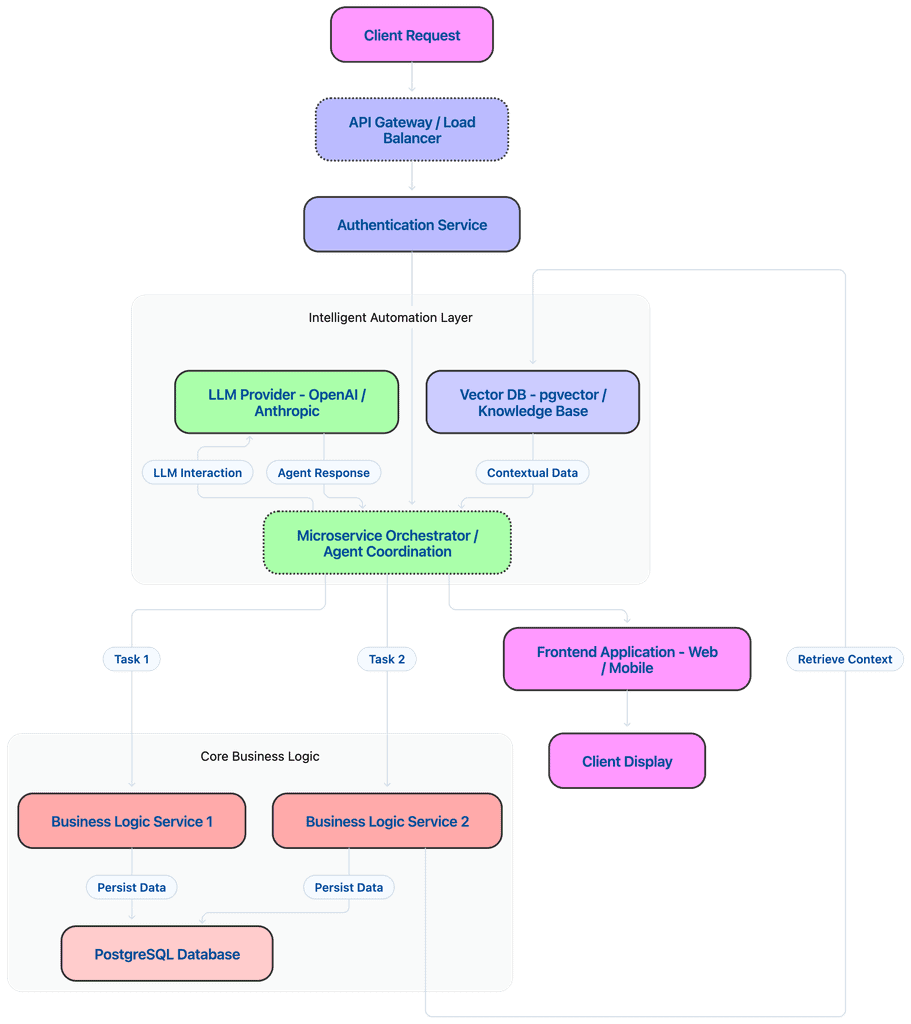
Simple Architectural Flow Illustrating Modular Services, AI/RAG Integration, and Data Persistence
This diagram illustrates a common modern architecture where a client request flows through an API gateway, authenticates, and is then handled by an orchestrator. This orchestrator might coordinate microservices for business logic, interact with an LLM, and augment the LLM’s knowledge through a vector database (RAG). All these services persist data in robust databases like PostgreSQL. This modularity allows for independent scaling and iterative development, key features of the “Best Software Company in Jamshedpur.”
How Qubimyst Labs Delivers Production-Grade Best Software Company in Jamshedpur Solutions
Qubimyst Labs LLP embodies the principles outlined above, positioning itself as a premier partner for businesses in Jamshedpur seeking sophisticated, high-performance software solutions. We specialize in transforming complex business requirements into scalable, production-ready applications, leveraging cutting-edge technology and a pragmatic, engineering-first approach. Our commitment is to deliver top-tier software engineering without unnecessary overhead, focusing on production stability, clear communication, modular architecture, and judicious AI adoption.
1. Custom Software & Bespoke Web Applications: Engineering for Impact
At Qubimyst Labs, custom software development means more than just coding; it’s about crafting a digital extension of your business logic, tailored precisely to your unique workflows and strategic objectives. For web applications, we employ a robust and battle-tested stack to ensure performance, scalability, and an exceptional user experience:
- Frontend Excellence (React, Next.js): We build modern, single-page (SPA) and server-rendered (SSR) applications with React and Next.js. React provides a component-based architecture for highly interactive and maintainable user interfaces. Next.js extends this with features like server-side rendering, static site generation, and API routes, optimizing for SEO, initial load times, and developer experience. This ensures your application is fast, responsive, and ranks well on search engines, critical for user engagement and business visibility.
- Robust Backend Development (Node.js): Our backend solutions are built primarily with Node.js, leveraging its non-blocking, event-driven architecture for high throughput and low latency. Node.js is ideal for building scalable APIs, microservices, and real-time applications. We design RESTful or GraphQL APIs that are secure, efficient, and provide a stable foundation for your frontend and mobile clients.
- Reliable Data Persistence (PostgreSQL, pgvector): PostgreSQL is our go-to relational database due to its reliability, extensibility, and advanced features. We design optimized schemas, implement robust data migrations, and ensure query performance. Crucially, for advanced AI applications, we leverage
pgvector, an extension that turns PostgreSQL into a capable vector database. This allows us to store and query high-dimensional vector embeddings directly alongside your structured data, which is fundamental for implementing Retrieval Augmented Generation (RAG) systems. For instance, storing product descriptions as vectors and instantly retrieving similar items for recommendations.
Example: A Custom B2B SaaS Platform
Imagine a B2B SaaS platform for supply chain optimization. Qubimyst Labs would architect this with a Next.js frontend for a dynamic dashboard, a Node.js microservices backend handling inventory, order processing, and analytics, all backed by a PostgreSQL database for transactional data. Furthermore, we might integrate a pgvector-powered RAG system to allow users to ask natural language questions about their historical supply chain reports or contractual documents, receiving precise answers derived from their private data.
2. Mobile Application Engineering: Reaching Users Everywhere
In today’s mobile-first world, a compelling mobile presence is vital. Qubimyst Labs specializes in cross-platform mobile development, ensuring broad reach without compromising on user experience or performance.
- Flutter (Dart): For applications demanding high performance, pixel-perfect UIs, and a native feel across both iOS and Android from a single codebase, Flutter is our preferred choice. Its “everything’s a widget” philosophy allows for rapid development of beautiful, custom UIs with excellent performance characteristics.
- React Native (JavaScript/TypeScript): For projects that need to leverage existing JavaScript expertise, integrate seamlessly with web teams, or prioritize faster development cycles with a single codebase, React Native offers a powerful solution. It compiles to native UI components, delivering a near-native user experience.
Our approach to mobile app development focuses on intuitive design, robust offline capabilities, secure data handling, and seamless integration with your backend services, ensuring a consistent and engaging experience across all devices.
3. Agentic AI Integration & Workflow Automation: Intelligent Systems for Business Advantage
The true power of AI lies in its ability to automate complex, cognitive tasks and provide intelligent assistance. Qubimyst Labs excels in integrating advanced AI solutions that drive real business value.
- Agentic AI Workflows: We design and implement multi-agent systems where AI agents collaborate to achieve specific business objectives. Using frameworks like CrewAI, we define agents with distinct roles, assign them tools (e.g., API callers, database query tools, web scrapers), and orchestrate their interactions.
- Use Case Example: An agentic system for lead qualification. One agent could browse public company data, another could analyze website content for specific keywords, and a third could synthesize the findings to score a lead’s potential, providing a summary to a sales team.
- LLM Integration: We integrate leading Large Language Models (LLMs) like OpenAI’s GPT series or open-source alternatives into your applications, enabling natural language understanding, generation, summarization, and complex reasoning. This powers chatbots, intelligent search, content creation tools, and more.
- Retrieval Augmented Generation (RAG): As mentioned, our use of
pgvectorwith PostgreSQL is central to our RAG implementations. We build robust knowledge bases from your proprietary documents, support tickets, internal wikis, or product manuals. When an LLM receives a query, our RAG system first retrieves the most relevant information from this knowledge base and then passes it to the LLM. This significantly reduces hallucinations, grounds responses in factual data, and allows your LLMs to speak intelligently about your specific business context.- Real-world Application: A customer support AI that can answer complex product-specific questions by querying your product documentation knowledge base via RAG, rather than relying solely on its general training data.
- Custom Automation Engines: Beyond AI, we build bespoke automation engines to streamline repetitive tasks, integrate disparate systems, and manage complex business processes, reducing manual effort and improving accuracy.
4. DevOps, Scalable Backend Architectures & Maintenance: Building for Longevity
A successful software solution requires more than just functional code; it demands a robust infrastructure, efficient deployment pipelines, and continuous maintenance.
- Scalable Backend Architectures: Our architects design systems that are inherently scalable, leveraging cloud-native services, microservices patterns, and optimized database strategies. We prioritize solutions that can handle fluctuating loads and grow with your business without requiring costly overhauls.
- Cloud Infrastructure: We deploy and manage applications on leading cloud platforms such as Amazon Web Services (AWS), Google Cloud Platform (GCP), and Microsoft Azure. Our expertise includes setting up virtual machines (EC2/Compute Engine), managed databases (RDS/Cloud SQL), serverless functions (Lambda/Cloud Functions), storage solutions (S3/Cloud Storage), and container orchestration (EKS/GKE).
- CI/CD Automation: We implement Continuous Integration and Continuous Deployment pipelines using tools like GitHub Actions, GitLab CI/CD, or Jenkins. This automates the build, test, and deployment processes, ensuring faster release cycles, consistent environments, and reduced human error.
- Robust DevOps Practices: Our DevOps philosophy integrates development and operations, fostering a culture of collaboration and automation. We set up comprehensive monitoring and logging solutions (e.g., Prometheus, Grafana, ELK stack) to proactively identify and resolve issues, ensuring high availability and performance.
- Ongoing Maintenance & Support: Software is a living entity. We provide comprehensive post-launch support, including bug fixes, security updates, performance optimizations, and feature enhancements. Our goal is to ensure your applications remain stable, secure, and performant over their entire lifecycle.
By partnering with Qubimyst Labs, businesses in Jamshedpur gain access to a team that not only builds exceptional software but also architects its foundation for long-term success, making us a clear choice for the Best Software Company in Jamshedpur. We invite decision-makers to contact us at sales@qubimystlabs.com or visit Qubimyst Labs LLP to discuss how we can bring your next big idea to life.
Real-World Application & Empirical Facts: The Jamshedpur Context
The insights and trends discussed are not abstract concepts; they are actively shaping the competitive landscape for businesses in Jamshedpur. The local economy, with its blend of heavy industry, emerging services, and entrepreneurial spirit, presents unique opportunities for digital transformation.
Industry reports, specifically those referenced in “Recent Technical Developments in Best Software Company in Jamshedpur 2026” (available at Qubimyst Labs), confirm a rapid acceleration in the adoption of sophisticated software solutions. This is not just about having a website or a simple mobile app; it’s about integrating AI-driven insights, automating core business processes, and building scalable platforms that can adapt to changing market demands. The report indicates a clear trend where businesses that embrace modular, AI-orchestrated, and RAG-enabled architectures are gaining significant advantages in efficiency, customer satisfaction, and innovation speed.
For Jamshedpur-based businesses, this translates into a critical imperative: partnering with a software company that possesses the foresight and technical capability to implement these advanced solutions. Relying on outdated technologies or generic off-the-shelf software can lead to significant technical debt, hinder scalability, and ultimately compromise competitive positioning. The local demand for robust web applications to streamline operations, mobile apps to engage customers, and AI solutions to optimize decision-making is soaring. The “Best Software Company in Jamshedpur” today must be fluent in these paradigms, offering not just development services but strategic technological guidance.
Consider the manufacturing sector, a cornerstone of Jamshedpur’s economy. Implementing custom software with AI-driven predictive maintenance (using agentic workflows to analyze sensor data), or RAG-powered knowledge bases for troubleshooting complex machinery, can yield massive operational efficiencies. Similarly, for emerging retail or logistics firms, bespoke web and mobile applications with intelligent inventory management and customer personalization features are no longer luxuries but necessities. The verified fact that “Industry reports show rapid acceleration in adoption for Best Software Company in Jamshedpur 2026” underscores the urgency and opportunity for local enterprises to embrace these technological advancements.
Comparative Analysis & Trade-off Matrix: Beyond the Hype
Choosing a software development model is a critical strategic decision. Each approach – in-house, freelance, or agency – presents distinct advantages and inherent trade-offs. Understanding these helps in identifying why engaging with a firm like Qubimyst Labs, the Best Software Agency in Jamshedpur, often strikes the optimal balance for growth-oriented enterprises.
1. In-House Development
- Pros: Maximum control over processes and intellectual property, deep institutional knowledge, direct cultural alignment, immediate availability for urgent issues.
- Cons: High overhead costs (salaries, benefits, office space, equipment), difficulty in attracting and retaining top-tier talent for specialized skills (e.g., specific AI expertise, niche backend languages), slow ramp-up time for new projects, potential for skill silos, single points of failure, technical debt accrual if best practices aren’t strictly enforced.
- Best For: Companies with very mature, extensive, and continuous software development needs where the core product is software, and they have the capital to invest heavily in a dedicated team and infrastructure.
2. Freelance Developers
- Pros: Lower hourly rates than agencies, flexibility in hiring for specific short-term tasks, direct communication with the developer.
- Cons: Reliability and commitment can vary significantly, single point of failure (if they get sick or leave, the project halts), limited scope of expertise (one person rarely masters all aspects of a complex project), lack of structured project management and QA processes, potential intellectual property issues if contracts aren’t meticulously drafted, security vulnerabilities due to isolated development practices. Managing multiple freelancers for a larger project can quickly become a full-time job.
- Best For: Small, well-defined, non-critical tasks that require a specific skill for a limited duration, or proof-of-concept work. Not suitable for production-grade systems.
3. Software Development Agencies (Like Qubimyst Labs)
- Pros:
- Comprehensive Expertise: Access to a diverse team of specialists (UI/UX designers, frontend, backend, mobile, AI engineers, DevOps) with collective experience across multiple industries and technologies.
- Structured Processes: Established project management methodologies (Agile), rigorous QA, and professional documentation.
- Scalability & Flexibility: Can quickly scale resources up or down based on project needs without recruitment overhead for the client.
- Reduced Risk: Agencies absorb the risk of talent acquisition, retention, and managing diverse skill sets. They provide built-in redundancy.
- Focus on Production Stability: Emphasis on robust architecture, security, and maintainability, ensuring long-term viability and lower total cost of ownership.
- Strategic Partnership: Act as a technology advisor, providing insights into future trends (e.g., AI adoption, modular architectures) and helping align technology with business strategy.
- Cons: Higher initial cost compared to a single freelancer (though often more cost-effective long-term when considering total cost of ownership and risk). Requires careful vendor selection to ensure cultural and technical alignment.
- Best For: Startups, SMEs, and growing enterprises seeking top-tier engineering without the overhead of building an in-house team, requiring a full-stack solution, or looking to integrate complex technologies like AI and advanced custom software.
Trade-off Matrix Summary:
| Factor | In-House | Freelance | Software Agency (e.g., Qubimyst Labs) |
|---|---|---|---|
| Cost | High (salaries, overhead) | Low (per-hour) | Moderate-High (value-driven) |
| Control | High | Variable | Moderate-High (via clear contracts) |
| Expertise Depth | Specific to team | Narrow | Broad & Specialized |
| Speed/Agility | Variable | Variable | High (dedicated, structured teams) |
| Scalability | Low (slow hiring) | Very Low | High (flexible resource allocation) |
| Risk | High (talent, tech debt) | Very High (reliability) | Low (established processes, redundancy) |
| Project Management | Internal | Client’s burden | Agency’s core competency |
| Long-Term Viability | High (if managed well) | Very Low | High (maintenance, strategic advice) |
Choosing a dedicated software agency like Qubimyst Labs allows businesses to leverage diverse, expert teams and battle-tested processes, circumventing the challenges of internal recruitment and freelance unpredictability. This model ensures that projects adhere to modern architectural best practices, deliver production stability, and are built to scale, minimizing the cost of technical debt often incurred by less rigorous approaches.