How Much Does It Cost to Build an E-commerce App in India?: A Practical Guide for Technology Leaders
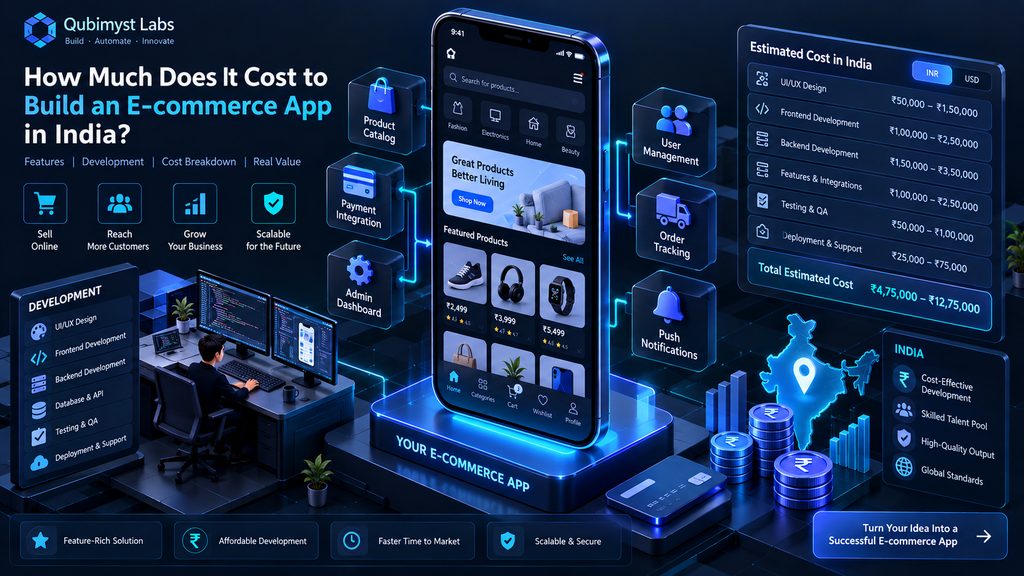
The Real Cost of Building an E-commerce App in India: A Strategic Investment Guide for 2026
India’s digital economy is undergoing a profound transformation, driven by an ever-expanding digital populace and an infrastructure that facilitates unparalleled connectivity. For businesses, educational institutions, and innovators looking to capitalize on this wave, establishing a robust e-commerce presence is no longer optional but an imperative. The mobile-first paradigm has made the e-commerce app a cornerstone of this strategy. However, prospective entrepreneurs and stakeholders often grapple with a fundamental question: “How much does it truly cost to build an e-commerce app in India?”
This comprehensive guide from Qubimyst Labs LLP aims to demystify the financial landscape of e-commerce app development in India for 2026. We will dissect the myriad factors influencing costs, from feature sets and technology choices to post-launch maintenance, providing a clear roadmap for budgeting and strategic planning. Our goal is to equip you with the insights needed to make informed decisions, ensuring your investment yields a sustainable, high-performing digital asset.
Table of Contents
- 1. Executive Overview: India’s E-commerce Boom and Mobile Imperative
- 2. Deconstructing the “Cost to Build an E-commerce App”: Why No Fixed Price?
- 3. Understanding the Core Cost Components
- 4. The Indian E-commerce App Development Landscape: Cost Ranges for 2026
- 5. Beyond Initial Development: The Total Cost of Ownership (TCO)
- 6. Strategic Considerations for Optimizing Your E-commerce App Budget
- 7. Qubimyst Labs LLP: Your Partner in E-commerce Innovation
- Conclusion
- AI Image Prompts
1. Executive Overview: India’s E-commerce Boom and Mobile Imperative
India’s e-commerce market is not merely growing; it’s undergoing an exponential expansion, positioning itself as one of the most dynamic digital marketplaces globally. This surge is fundamentally powered by an unprecedented penetration of smartphones and a robust digital payment infrastructure. With over 900 million smartphone users (colorleaves.in) and UPI transactions consistently crossing 16 billion per month (colorleaves.in), mobile commerce has cemented its status as the default method for consumer purchases across the nation.
For businesses, institutes, and colleges aiming to engage with this vast digital audience, an e-commerce app is no longer a luxury but a strategic necessity. It offers direct access to consumers, streamlines purchasing experiences, and enables personalized engagement. However, the investment required to build such an application is a primary concern. It’s crucial to understand from the outset that the “cost to build an e-commerce app” is not a fixed figure. Instead, it’s a highly variable outcome influenced by a spectrum of factors, including desired features, complexity, chosen technology stack, target platforms (iOS, Android, or cross-platform solutions like Flutter), and the overarching long-term business objectives. Recognizing this variability is the first step toward effective budgeting and a successful e-commerce venture in India.
2. Deconstructing the “Cost to Build an E-commerce App”: Why No Fixed Price?
The question “How much does it cost to build an e-commerce app in India?” is akin to asking “How much does it cost to build a house?” The answer is inherently complex because the scope of “an e-commerce app” or “a house” can vary dramatically. You could be envisioning a basic, single-vendor storefront with core transaction capabilities, or a sophisticated, multi-vendor marketplace incorporating AI-driven recommendations, augmented reality product views, and intricate loyalty programs. Each element—from the foundational architecture to the minutiae of user experience—contributes directly to the overall effort and, consequently, the expense.
The variability in e-commerce app development costs in India for 2026 is driven by several interdependent factors. These include the sheer volume and complexity of features, the choice between native or cross-platform development, the specific technologies employed for the backend and frontend, the intricacy of the UI/UX design, and the expertise level and geographic location of the development team. Furthermore, business goals, such as anticipated user scale, future scalability requirements, and specific market differentiators, significantly shape the development approach and budget. A clear understanding of these variables is paramount for any stakeholder embarking on an e-commerce app development journey.
3. Understanding the Core Cost Components
Developing an e-commerce app is a multi-faceted project, and its cost is an aggregation of various components. Each element demands dedicated resources, specialized expertise, and time, directly contributing to the final expenditure. Dissecting these core components is essential for constructing a realistic budget.
3.1. Feature Set and Functionality
The scope of features is perhaps the most significant determinant of an e-commerce app’s cost. A Minimum Viable Product (MVP) prioritizes core functionalities, allowing for quicker market entry and iterative development, whereas a fully-featured, enterprise-grade application demands extensive development cycles.
Essential Features (Typical for MVP):
- User Profiles & Authentication: Secure registration, login (email/social), profile management.
- Product Catalog: Detailed product listings with images, descriptions, pricing, inventory.
- Search & Filters: Efficient product discovery through keywords, categories, attributes.
- Shopping Cart: Add, remove, update quantities, save for later.
- Checkout Process: Secure, multi-step checkout with address management.
- Payment Gateway Integration: Support for various payment methods (UPI, net banking, cards, COD).
- Order Management: Order history, status tracking, cancellations.
- Customer Support: Basic contact forms or FAQ sections.
Advanced Features (Adding Complexity & Cost):
- AI-driven Personalization & Recommendations: Machine learning algorithms to suggest products based on user behavior.
- Multi-vendor Support: Features for multiple sellers to list and manage their products (e.g., a marketplace model).
- Augmented Reality (AR) & Virtual Try-on: Enhancing product visualization.
- Loyalty Programs & Gamification: Rewards, points, referral systems.
- Push Notifications: Real-time updates for orders, promotions, abandoned carts.
- In-app Chat/Support: Integrated communication with customer service.
- Advanced Analytics & Reporting: Comprehensive dashboards for business insights.
- Wishlist & Favorites: Saving products for future consideration.
- Reviews & Ratings: User-generated content for social proof.
- Inventory Management System (IMS) Integration: Synchronizing app inventory with backend systems.
- CRM Integration: Connecting with customer relationship management tools.
- Localization: Multi-language and multi-currency support.
The more advanced and complex the features, the greater the development time, requiring specialized skills, which escalates the cost. For instance, an app with basic features (MVP) might take 3-6 months to build, whereas an enterprise-grade solution could extend to 12-18 months or more.
3.2. Platform Choice: Native (iOS/Android) vs. Cross-Platform (Flutter/React Native)
The decision regarding target platforms significantly impacts development time and cost.
- Native Development (iOS and Android Separately):
- Pros: Offers the best performance, responsiveness, and access to all device-specific features (e.g., camera, GPS, sensors). Provides a truly platform-specific user experience.
- Cons: Requires two separate codebases (Swift/Kotlin), two distinct development teams, leading to higher development time and cost. Maintenance and updates also need to be done twice.
- Cost Implication: Highest cost due to duplicated effort, but offers premium performance and user experience.
- Cross-Platform Development (Flutter, React Native):
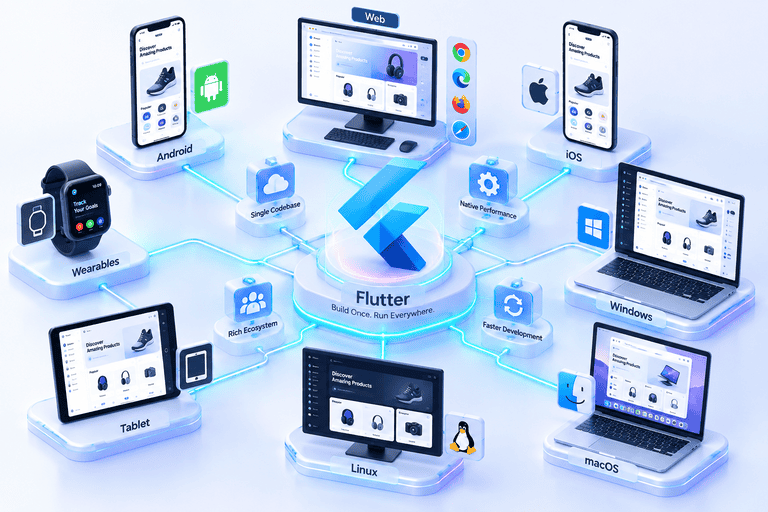
- Pros: Allows a single codebase to run on both iOS and Android, significantly reducing development time and cost (often by 30-50%). Easier maintenance and faster updates. Frameworks like Flutter Official Docs offer near-native performance and rich UI capabilities.
- Cons: May have limitations in accessing highly specific native device features directly (though plugins often bridge this gap). Performance, while excellent, might not always match truly native apps in extreme cases.
- Cost Implication: More cost-effective for reaching a broad audience quickly without compromising too much on performance. Often the preferred choice for budget-conscious projects or MVPs that need to scale.
The choice largely depends on your budget, timeline, performance requirements, and desired level of platform-specific integration. For many e-commerce applications in India, cross-platform solutions provide an optimal balance of cost-efficiency and market reach.
3.3. Technology Stack
The selection of technologies for both the frontend (what users see) and backend (server, database, APIs) is a critical cost driver.
- Frontend (Mobile App):
- Native: Swift/Objective-C for iOS, Kotlin/Java for Android.
- Cross-Platform: Dart with Flutter, JavaScript with React Native.
- Backend (Server-Side Logic, Database, APIs):
- Programming Languages: Node.js (JavaScript), Python (Django/Flask), Java (Spring Boot), Ruby on Rails, PHP (Laravel).
- Databases: PostgreSQL (relational, robust), MongoDB (NoSQL, flexible), MySQL.
- Cloud Infrastructure: Amazon Web Services (AWS), Google Cloud Platform (GCP), Microsoft Azure. These provide scalable server, storage, and networking resources. Their costs are typically ongoing and depend on usage.
- APIs: Application Programming Interfaces facilitate communication between the mobile app, backend, and third-party services (payment gateways, shipping providers, analytics tools).
- Admin Panel (Web-based): Often built with frameworks like React, Angular, or Vue.js, connecting to the same backend.
The complexity of the chosen stack, the availability of developers proficient in those technologies, and the need for custom integrations all influence the development cost. Leveraging open-source technologies can sometimes reduce licensing costs, but expertise in configuring and maintaining them is still required.
3.4. UI/UX Design
User Interface (UI) and User Experience (UX) design are paramount for an e-commerce app’s success. A well-designed app is intuitive, engaging, and encourages repeat usage.
- UX Design (User Experience): Focuses on making the app easy and pleasant to use. This involves:
- User Research: Understanding target audience needs and behaviors.
- Information Architecture: Structuring content logically.
- Wireframing: Basic structural layouts of app screens.
- Prototyping: Interactive mockups to simulate app flow.
- User Testing: Gathering feedback to refine the experience.
- UI Design (User Interface): Deals with the visual elements and interactivity. This includes:
- Visual Design: Colors, typography, iconography, imagery.
- Branding: Ensuring consistency with brand guidelines.
- Interactive Elements: Buttons, forms, animations.
The effort dedicated to UI/UX design directly impacts user adoption and retention. Custom, highly intuitive, and visually appealing designs naturally incur higher costs than template-based or minimalistic approaches. An experienced UI/UX team ensures the app is not just functional but also a delight to use, which is critical for converting casual browsers into loyal customers.
3.5. Development Team Structure and Location
The cost of development is heavily influenced by the expertise, size, and geographic location of your development team.
- Team Composition: A typical e-commerce app development team includes:
- Project Manager
- Business Analyst
- UI/UX Designers
- Frontend/Mobile Developers (iOS, Android, or Cross-Platform)
- Backend Developers
- QA Testers
- DevOps Engineer (for deployment and infrastructure management)
- Engagement Models:
- In-house Team: High fixed costs (salaries, benefits, infrastructure) but full control.
- Freelancers: Can be cost-effective for small projects but might lack comprehensive oversight and scalability.
- Development Agencies/Firms: Offer a full suite of services, from design to deployment, with project management and quality assurance. This is often the most balanced approach for complex projects.
- Geographic Location: Hourly rates for developers vary significantly across different regions. While India offers highly competitive rates compared to North America or Western Europe, the quality of talent remains high.
- Hourly Rates in India: Typically range from $20 to $50+ per hour, depending on the firm’s reputation, developer experience, and specific technology expertise. A boutique agency like Qubimyst Labs LLP, focusing on custom solutions and AI, might command rates at the higher end of this spectrum, reflecting their specialized knowledge and commitment to quality.
The choice of partner and their location directly impacts the development budget. Opting for a reputable firm in India provides access to skilled professionals at a more favorable cost-to-quality ratio.
4. The Indian E-commerce App Development Landscape: Cost Ranges for 2026
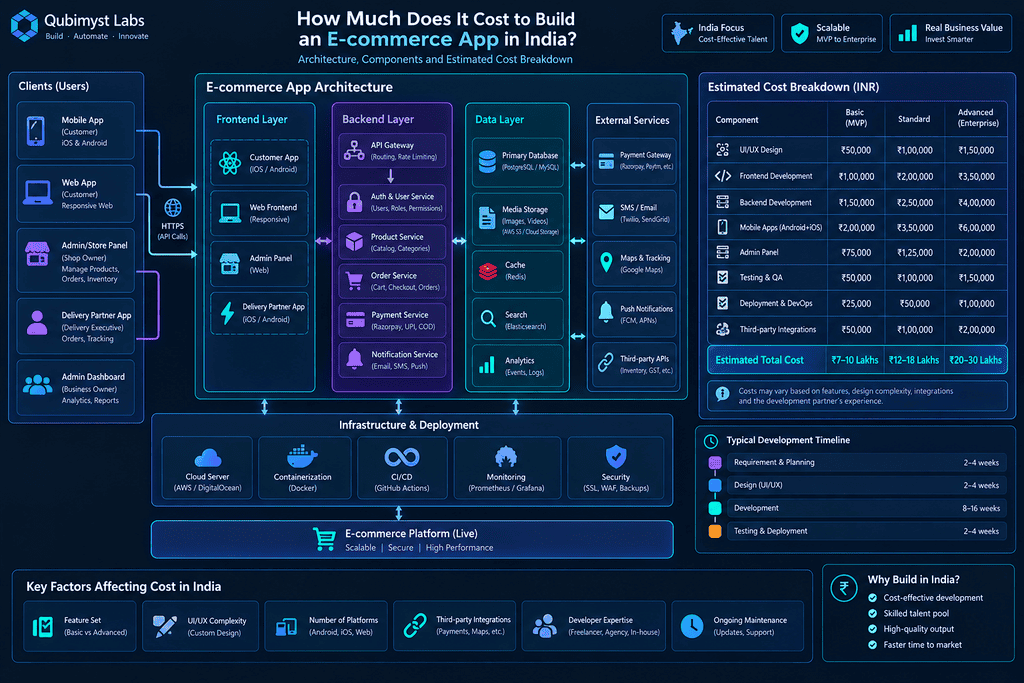
Given the multitude of influencing factors, providing a single cost for an e-commerce app in India is impossible. However, based on market insights for 2026, we can delineate broad ranges tied to complexity:
One notable source suggests the e-commerce app development cost in India in 2026 ranges from ₹3 Lakhs to ₹50 Lakhs (colorleaves.in). Another report mentions an average cost for custom e-commerce application development in India for 2026 as approximately ₹6,00,000 to ₹15,00,000 (interpreting the likely typo in devicedoctorindia.in’s quote of “₹6,00,000 to ₹1,50,000” as ₹15,00,000, given market reality). This wider bracket reflects the diverse requirements of various businesses.
To provide a more granular understanding, we can categorize e-commerce apps into three primary tiers:
- 1. Basic E-commerce App (MVP – Minimum Viable Product):
- Features: Core functionalities like user registration, product listings, shopping cart, basic checkout, single payment gateway, order history. Minimal custom UI/UX. Focus on rapid deployment and validating a business idea.
- Platforms: Often single-platform (Android or iOS) or a basic cross-platform solution.
- Development Time: 3-6 months.
- Estimated Cost in India (2026): ₹3 Lakhs to ₹8 Lakhs.
- This tier is ideal for startups or small businesses testing the waters with essential online selling capabilities.
- 2. Mid-range E-commerce App:
- Features: All basic features, plus advanced search/filters, wishlist, product reviews, push notifications, multiple payment options, basic analytics, CRM integration, and a more polished, custom UI/UX. Potentially includes a basic admin panel for inventory and order management.
- Platforms: Typically cross-platform (Flutter/React Native) to cover both iOS and Android, or native development for one platform with plans for the other.
- Development Time: 6-12 months.
- Estimated Cost in India (2026): ₹8 Lakhs to ₹25 Lakhs.
- This category suits established SMEs looking for a competitive edge, robust user engagement, and a scalable foundation.
- 3. Complex / Enterprise-grade E-commerce App:
- Features: Comprehensive functionalities including AI-driven recommendations, AR/VR integration, multi-vendor support, advanced inventory management, sophisticated loyalty programs, in-app chat, robust security features, integration with ERP/CRM systems, advanced analytics, custom backend, and highly personalized, premium UI/UX. Built for high traffic and extensive scalability.
- Platforms: Often native development for both iOS and Android for peak performance, or highly optimized cross-platform solutions.
- Development Time: 12-18+ months.
- Estimated Cost in India (2026): ₹25 Lakhs to ₹50 Lakhs and beyond.
- This tier is for large enterprises, marketplaces, or businesses requiring highly specialized functionalities, intricate integrations, and the highest levels of performance and security.
It’s important to recognize these are estimates. A thorough discovery phase is essential to accurately scope the project and provide a precise quotation. The complexity of features, the chosen technology, and the expertise of the development partner will ultimately dictate the final investment.
5. Beyond Initial Development: The Total Cost of Ownership (TCO)
Focusing solely on the upfront development cost provides an incomplete picture. A robust e-commerce app requires continuous investment to remain operational, secure, and competitive. Neglecting these post-launch expenses can lead to technical debt, security vulnerabilities, and a degraded user experience. When planning an e-commerce development budget, it’s crucial to consider the overall 3-year Total Cost of Ownership (TCO), beyond just the initial development expenditure (akoode.com).
5.1. Maintenance and Support
Software is never truly “finished.” It requires ongoing care to perform optimally.
- Bug Fixing: Addressing unforeseen issues that arise post-launch.
- Performance Optimization: Ensuring the app remains fast and responsive as user base and data grow.
- Security Patches & Updates: Regularly updating libraries, frameworks, and OS dependencies to protect against vulnerabilities.
- OS Compatibility Updates: Ensuring the app functions correctly with new versions of iOS and Android.
- Third-party API Updates: Adjusting to changes in payment gateways, shipping APIs, or other integrated services.
- Cost: Typically, 15-20% of the initial development cost annually, depending on the complexity and support level.
5.2. Infrastructure Costs
The app needs a home. This includes servers, databases, and network resources.
- Hosting: Cloud services like AWS, GCP, or Azure provide scalable infrastructure. Costs are usage-based and can vary significantly depending on traffic, storage, and data transfer.
- Database Management: Licensing or operational costs for database servers.
- Content Delivery Network (CDN): Essential for fast loading times globally by caching content closer to users.
- Backup & Disaster Recovery: Implementing robust solutions to prevent data loss and ensure business continuity.
- Cost: Can range from a few thousand rupees per month for small apps to several lakhs for high-traffic, enterprise-level applications.
5.3. Marketing and User Acquisition
Building a great app is only half the battle; users need to discover it.
- App Store Optimization (ASO): Optimizing app listings (keywords, descriptions, screenshots) for better visibility in app stores.
- Digital Marketing: Running campaigns on social media, search engines, and other platforms to drive downloads and engagement.
- Influencer Marketing: Collaborating with influencers to promote the app.
- Promotions & Discounts: Offering incentives to attract new users and encourage purchases.
- Cost: This is an ongoing operational cost that can be as significant as, or even exceed, the development cost, depending on your growth objectives.
5.4. Feature Enhancements and Scalability
Successful e-commerce apps evolve. User feedback, market trends, and competitive pressures necessitate continuous improvement.
- New Feature Development: Adding functionalities to enhance user experience or introduce new services.
- Scalability Upgrades: Modifying the architecture or infrastructure to handle increased user load and data volume.
- A/B Testing: Experimenting with different features or UI elements to optimize conversions.
- Cost: Varies greatly based on the scope of new features and frequency of updates. It’s a strategic investment to maintain relevance and competitive advantage.
5.5. Security Audits and Compliance
Protecting user data and maintaining trust are non-negotiable, especially for e-commerce.
- Regular Security Audits: Conducting vulnerability assessments and penetration testing to identify and fix security loopholes. Adhering to standards like the OWASP Application Security Standard is crucial.
- Data Privacy Compliance: Ensuring adherence to regulations like GDPR, CCPA, or India’s upcoming data protection laws.
- Payment Card Industry Data Security Standard (PCI DSS): If you handle credit card information directly, compliance is mandatory.
- Cost: Periodic audits and ongoing security measures are essential investments, protecting both your business reputation and your users.
Understanding and budgeting for these ongoing costs from the outset is vital for long-term success, transforming your initial app development into a sustainable and profitable venture.
6. Strategic Considerations for Optimizing Your E-commerce App Budget
Building an e-commerce app is a significant investment, but it doesn’t have to be financially daunting. Strategic planning and informed decision-making can help optimize your budget without compromising on quality or functionality.
6.1. Define Your MVP (Minimum Viable Product)
Start lean. Clearly define the core problem your app solves and identify the absolute essential features required to address it. An MVP allows you to launch faster, gather real user feedback, and iterate based on market demand, reducing initial development costs and risks. Prioritize features that deliver immediate value and defer advanced functionalities for later phases.
6.2. Choose the Right Technology Stack
Your technology choices directly impact cost, scalability, and maintainability. Opt for proven, robust, and widely supported technologies. While cutting-edge tech can be appealing, it might come with higher development costs due to scarcer expertise. Carefully weigh the pros and cons of different backend frameworks, databases, and cloud providers based on your specific needs and long-term vision.
6.3. Opt for Cross-Platform Development (Where Appropriate)
For many e-commerce scenarios, cross-platform frameworks like Flutter or React Native offer a significant cost advantage. By maintaining a single codebase for both iOS and Android, you reduce development time, testing efforts, and ongoing maintenance costs compared to building two separate native applications. Evaluate if the performance and platform-specific feature access of cross-platform solutions meet your requirements.
6.4. Focus on UI/UX from Day One
While custom UI/UX design adds to the initial cost, it’s a critical investment that pays dividends in user retention and conversion. A poorly designed app leads to frustration and abandonment. Investing in a thoughtful, intuitive, and visually appealing user experience from the outset minimizes redesign costs down the line and ensures your app stands out in a crowded market.
6.5. Partner with a Competent Development Firm
The cheapest option is rarely the best in software development. Engaging a reputable development firm that understands your business goals, has a proven track record in e-commerce, and offers transparency in its processes is crucial. A skilled team brings expertise in architecture, security, scalability, and user experience, which ultimately saves money by building it right the first time. Firms like Qubimyst Labs LLP prioritize delivering robust, scalable, and secure solutions that align with long-term strategic objectives.
6.6. Plan for Post-Launch Phases
As discussed, the initial development cost is just one part of the total cost of ownership. Allocate a significant portion of your budget for ongoing maintenance, security updates, infrastructure scaling, and future feature enhancements. A well-planned post-launch strategy prevents unexpected expenses and ensures your app remains performant, secure, and relevant.
7. Qubimyst Labs LLP: Your Partner in E-commerce Innovation
Navigating the complexities of building an e-commerce app in India demands more than just technical prowess; it requires a strategic partner who understands market dynamics, anticipates future trends, and translates business vision into tangible digital solutions. At Qubimyst Labs LLP, we specialize in Custom Software & AI Solutions, offering a holistic approach to e-commerce app development that goes beyond mere coding.
Our expertise extends from meticulous discovery and strategic planning to sophisticated UI/UX design, robust backend engineering, and seamless multi-platform deployment. We are adept at leveraging cutting-edge technologies and integrating advanced features, including AI-driven personalization and scalable cloud infrastructures, to craft e-commerce experiences that resonate with the Indian consumer base.
We understand that every business has unique requirements and budget constraints. Our team of experienced principal software engineers collaborates closely with clients—be it business owners, educational institutions, or emerging startups—to define the optimal feature set, select the most appropriate technology stack (including efficient cross-platform solutions like Flutter), and architect a solution that is not only cost-effective for 2026 but also sustainable and scalable for years to come.
From concept to launch and beyond, Qubimyst Labs LLP is committed to delivering high-quality, secure, and high-performing e-commerce applications. We don’t just build apps; we engineer digital growth platforms designed to empower your business, enhance user engagement, and drive measurable ROI in India’s vibrant e-commerce landscape.
Conclusion
The journey of building an e-commerce app in India for 2026 is a strategic investment in a rapidly expanding digital economy. While the “cost to build an e-commerce app” is not a static figure, it is a calculable outcome of well-defined features, judicious technology choices, meticulous design, and competent execution. From a basic MVP ranging from ₹3 Lakhs to ₹8 Lakhs to a sophisticated enterprise solution potentially exceeding ₹50 Lakhs, the spectrum is broad, reflecting the diversity of business ambitions.
However, the initial development cost represents only a fraction of the total investment. Strategic foresight must encompass the Total Cost of Ownership, including ongoing maintenance, infrastructure, security, and future enhancements. By adopting a phased approach, prioritizing core functionalities, and partnering with an experienced development firm, businesses can optimize their budget and ensure their e-commerce app not only launches successfully but thrives in the competitive Indian market.