
The evolution of Generative AI from chatbots and content generation into multimodal, agentic, personalized, and production grade AI systems: A Practical Guide for Technology Leaders
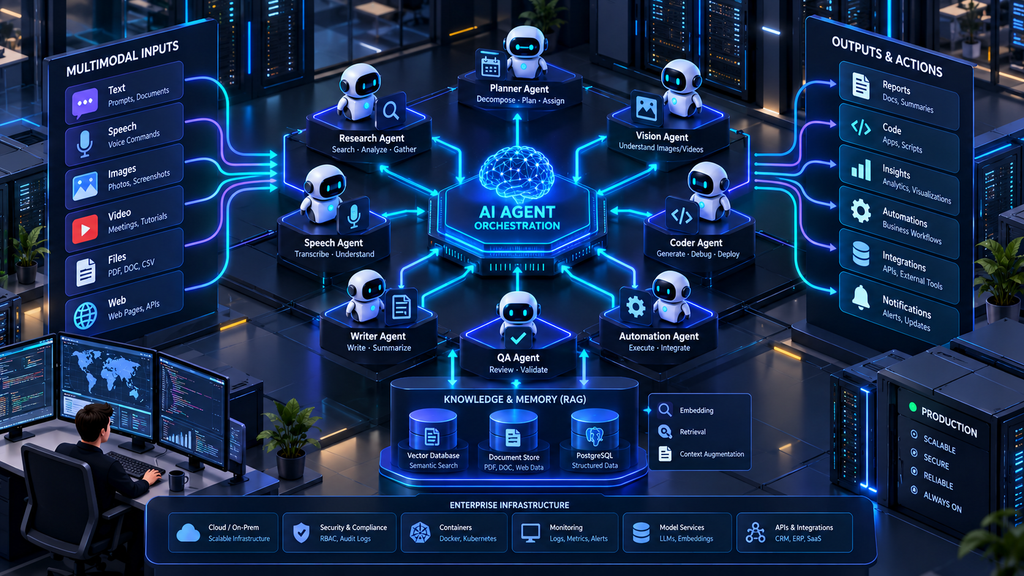
Generative AI Trends 2027: Evolving from Chatbots to Multimodal, Agentic, and Production-Grade Systems
The landscape of artificial intelligence is in a perpetual state of accelerated evolution. What began as experimental large language models (LLMs) powering conversational agents and simple content generation has rapidly matured into sophisticated, integrated systems capable of autonomous action, personalized interaction, and robust enterprise deployment. This shift defines the current trajectory of Generative AI, positioning it as a foundational layer for next-generation software architectures and business operations, a transformation increasingly critical for modern engineering workflows.
By 2027, the conceptual understanding of Generative AI will have transcended its initial applications. Technology leaders, startup founders, and product managers are no longer merely contemplating how to leverage AI for static content; they are strategizing around dynamic, agentic systems that orchestrate complex tasks, interpret diverse data modalities, and deliver highly customized experiences at scale. This article explores the defining characteristics of this evolution, delves into the architectural and strategic imperatives for adoption, and outlines best practices for integrating these advanced Generative AI capabilities into production environments.
Table of Contents
- 1. Executive Overview
- 2. The Genesis: From Chatbots to Content Engines (A Brief Retrospective)
- 3. Generative AI Trends 2027: A New Horizon
- 4. Architectural Considerations for Enterprise Generative AI
- 5. Best Practices for Developing and Deploying Advanced Generative AI
- 6. The Strategic Imperative: Evaluating and Adopting Advanced Generative AI
- 7. Conclusion: Navigating the Future of Intelligent Automation
- 8. Empowering Your AI Vision with Qubimyst Labs
1. Executive Overview
The trajectory of Generative AI is shifting from static content generation to dynamic, autonomous, and integrated systems. By 2027, enterprise adoption will be predicated on AI solutions that are multimodal, capable of understanding and generating across various data types; agentic, performing complex, multi-step tasks autonomously; and deeply personalized, tailoring interactions to individual user contexts. This evolution necessitates a rigorous focus on production grade qualities: scalability, reliability, security, and integration within existing IT infrastructure. Technology leaders are tasked with evaluating solutions that not only demonstrate innovative capabilities but also adhere to stringent operational standards and best practices for modern software development. Organizations leveraging modern architecture consistently report improved productivity and system reliability, underscoring the critical importance of a robust foundation for advanced AI deployments.
2. The Genesis: From Chatbots to Content Engines (A Brief Retrospective)
The initial wave of Generative AI captured public imagination through large language models (LLMs) and diffusion models. These early iterations primarily excelled at text-to-text or text-to-image transformations. Chatbots offered a novel way to interact with information, drafting emails, summarizing documents, or brainstorming ideas. Content generation tools automated the creation of articles, marketing copy, or basic visual assets. This phase, while groundbreaking, also exposed inherent limitations:
- Contextual Boundedness: Models often struggled with sustained, complex dialogues requiring memory and nuanced understanding beyond short prompts.
- Lack of Agency: Outputs were reactive; the AI generated content but could not independently plan or execute actions based on that content or external stimuli.
- Modality Specificity: Most models were confined to a single modality, making it challenging to process and synthesize information from, for example, a conversation, a chart, and a video simultaneously.
- Generic Outputs: While impressive, the generated content often lacked the deeply personalized touch or specific domain expertise required for critical business operations.
- Production Challenges: Integrating these nascent models into existing enterprise systems for reliable, scalable, and secure operations presented significant hurdles. Data privacy, model governance, and interpretability were often afterthoughts, if considered at all.
Despite these limitations, this foundational period demonstrated the immense potential of Generative AI, laying the groundwork for the more sophisticated and enterprise-ready systems emerging as Generative AI trends 2027 take hold.
3. Generative AI Trends 2027: A New Horizon
The next three years will see a profound transformation in how Generative AI is conceptualized, developed, and deployed. The focus will shift decisively towards systems that are interconnected, intelligent beyond mere pattern recognition, and deeply integrated into operational workflows.
3.1. Multimodal AI: Beyond Text and Pixels
Multimodal AI represents a significant leap from specialized models. Instead of processing text, images, audio, or video in isolation, multimodal systems can seamlessly understand, interpret, and generate content across these diverse data types. This capability mirrors human cognition, where we naturally combine sensory inputs to form a holistic understanding of our environment.
Key characteristics of Multimodal AI:
- Integrated Understanding: A multimodal model can process a customer’s spoken query, analyze an accompanying screenshot, and retrieve relevant product documentation (text) to formulate a comprehensive response that might include a visual guide or an audio summary.
- Cross-Modal Generation: The ability to generate an image from a textual description, then add a relevant voiceover, or create an animation from a combination of text and audio input. This facilitates richer, more engaging user experiences and comprehensive content creation.
- Enhanced Context: By correlating information from various sources, multimodal AI can build a much richer and more accurate contextual understanding, leading to more relevant and insightful outputs. For instance, in healthcare, a multimodal AI could analyze patient records (text), medical images (visual), and even sensor data (numerical) to assist with diagnosis or treatment planning.
Business applications will expand dramatically:
- Customer Experience: Advanced chatbots that can understand nuanced voice commands, analyze customer sentiment from facial expressions in video calls, and provide highly relevant multimedia responses.
- Product Design & Development: Engineers leveraging multimodal AI to interpret design specifications (text), generate 3D models (visual), and simulate performance (numerical data), with iterative feedback loops driven by verbal commands or sketches.
- Media & Entertainment: Automated generation of complex scenes, characters, and soundtracks based on high-level narrative prompts, accelerating content production.
- Augmented Reality/Virtual Reality: Creating dynamic, interactive environments that respond to user’s speech, gestures, and even emotional states.
The technical challenge lies in training models to learn robust cross-modal representations and handle the complexities of data alignment and fusion. However, the promise of more intuitive and powerful AI interactions is driving significant investment and research in this domain.
3.2. Agentic AI: From Generation to Autonomous Action
Agentic AI marks the transition from systems that generate outputs to systems that act. An AI agent is not merely a sophisticated chatbot; it is an autonomous entity capable of understanding complex goals, breaking them down into sub-tasks, planning a sequence of actions, executing those actions using various tools (APIs, databases, external software), monitoring its progress, and adapting its plan based on real-time feedback.
Core components of an AI agent:
- Goal Comprehension: Interpreting high-level directives into actionable objectives.
- Planning Module: Devising a multi-step strategy to achieve the goal, including tool selection and task sequencing.
- Memory: Maintaining context, learning from past interactions, and storing relevant information for future tasks.
- Tool Use: Interfacing with external systems and applications via APIs to gather information, perform operations, or trigger workflows. This can range from querying a CRM to invoking a code compiler.
- Execution & Monitoring: Carrying out planned actions and observing outcomes, adjusting strategy if necessary.
- Reflection & Learning: Evaluating performance, identifying failures or inefficiencies, and refining its internal models or strategies for future tasks.
Transformative impact on enterprise operations:
- Automated Workflows: Beyond simple RPA, agentic AI can handle dynamic, non-standard processes. For instance, an agent could manage a complex customer support issue from end-to-end: gathering information, diagnosing the problem, scheduling a technician, communicating updates to the customer, and even processing refunds, all while adhering to business rules. This custom workflow automation is projected to reduce manual operational overhead by up to 40%.
- Software Development: AI agents assisting developers by writing code, identifying bugs, optimizing performance, and even deploying applications, acting as highly capable co-pilots or even autonomous devops assistants.
- Research & Analysis: Agents capable of sifting through vast datasets, synthesizing information from multiple sources, and generating comprehensive reports or even conducting scientific experiments in simulation environments.
- Strategic Decision Support: Autonomous agents monitoring market trends, analyzing internal data, and proactively recommending strategic adjustments or identifying emerging opportunities.
The transition to agentic AI requires robust frameworks for defining goals, secure access to enterprise systems, and comprehensive monitoring to ensure agents operate within defined parameters and ethical guidelines. The challenge lies not just in the AI’s intelligence, but in engineering trust and control into these autonomous systems.
3.3. Personalized Generative Experiences
Generic content, even if high-quality, is increasingly insufficient for engaging modern users and achieving specific business outcomes. Generative AI is evolving to deliver deeply personalized experiences, adapting its outputs based on individual user profiles, historical interactions, preferences, and real-time context.
Key drivers of personalization:
- User Modeling: Sophisticated techniques for building rich, dynamic profiles of individual users, customers, or employees, encompassing their behavior, preferences, skills, and goals.
- Contextual Awareness: AI systems becoming acutely aware of the immediate operational context – what the user is currently doing, where they are in a workflow, what information they have already processed.
- Adaptive Generation: The ability of the AI to dynamically adjust its tone, style, content, and even modality (e.g., text, voice, visual) to best suit the individual recipient and the situation.
Applications across industries:
- Marketing & Sales: Hyper-personalized advertising content, product recommendations, and sales communications that resonate deeply with individual prospects, driving higher conversion rates.
- Education: Adaptive learning platforms that generate customized curricula, explanations, and exercises tailored to a student’s learning style, pace, and knowledge gaps.
- Healthcare: Personalized patient education materials, treatment plans, and wellness recommendations based on individual health data, lifestyle, and preferences.
- Employee Enablement: Intelligent assistants that provide context-aware support, generate personalized reports, or offer tailored training modules for employees based on their role, projects, and skill development needs.
Achieving true personalization requires robust data pipelines, ethical data governance, and models capable of fine-grained adaptation without overfitting or compromising user privacy. The value proposition is clear: highly relevant, engaging, and effective interactions that drive superior outcomes.
3.4. Production-Grade AI: Reliability, Security, and Scale
The shift from experimental models to mission-critical enterprise systems demands a rigorous focus on “production-grade” attributes. By 2027, the success of Generative AI deployments will hinge on their ability to operate reliably, securely, and scalably within complex enterprise environments.
Essential production-grade considerations:
- Scalability: Generative AI solutions must handle fluctuating demand, supporting thousands or millions of users and high-volume data processing without performance degradation. This requires distributed architectures, efficient inference engines, and intelligent resource allocation.
- Reliability & Resilience: Systems must be designed for continuous operation, with robust error handling, fault tolerance, and self-healing capabilities. Downtime for critical AI services is unacceptable.
- Security & Privacy: Given the sensitive nature of data processed by AI, stringent security measures are paramount. This includes secure data ingress/egress, model protection, access control, compliance with regulations like GDPR and HIPAA, and robust data anonymization/pseudonymization techniques.
- Observability & Monitoring: Comprehensive logging, tracing, and metric collection are essential for understanding model behavior, identifying performance bottlenecks, detecting drift, and ensuring compliance. Real-time dashboards and alerting mechanisms become critical.
- Integrability: Advanced Generative AI systems must integrate seamlessly with existing enterprise applications, databases, and workflows. This necessitates well-documented APIs, adherence to industry standards, and flexible integration patterns.
- Governance & Explainability: For enterprise adoption, stakeholders need to understand how AI makes decisions or generates content. Governance frameworks ensure models align with business policies, ethical guidelines, and regulatory requirements. Explainable AI (XAI) techniques provide transparency into model reasoning.
These factors are key architectural considerations for the evolution of Generative AI into production-grade systems. Over 75% of technology teams prioritize modular scalable infrastructure, recognizing that a solid architectural foundation is non-negotiable for successful long-term AI strategy.
4. Architectural Considerations for Enterprise Generative AI
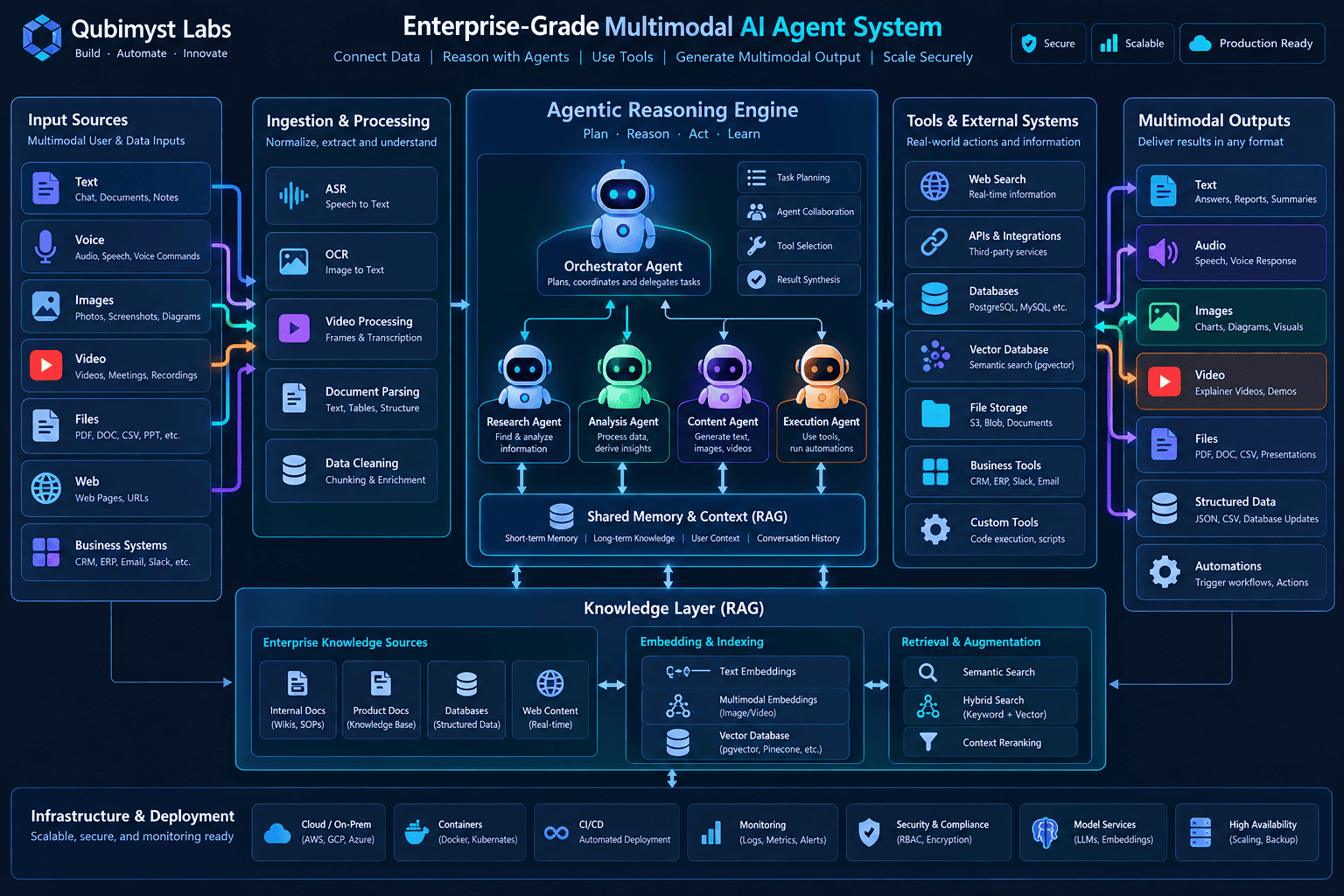
Building production-grade Generative AI systems requires a thoughtful approach to architecture that goes beyond simply deploying an LLM. The focus must be on creating a resilient, scalable, secure, and maintainable ecosystem.
Key architectural patterns and principles:
- Modular, Scalable Infrastructure: Decoupling components allows for independent scaling, updates, and maintenance. This often involves microservices or serverless architectures deployed on cloud platforms (AWS, Azure, GCP). Containerization (e.g., Docker) and orchestration (e.g., Kubernetes) are foundational for managing these complex deployments efficiently.
- Hybrid AI Architectures: Combining proprietary models with open-source alternatives, and leveraging both cloud-based and on-premise inference capabilities for data locality, security, and cost optimization. This might involve fine-tuning smaller, specialized models for specific tasks on private infrastructure while utilizing larger, general-purpose models via cloud APIs.
- Robust Data Pipelines: Establishing secure, efficient, and auditable pipelines for data ingestion, cleaning, transformation, and storage. This is crucial for training, fine-tuning, and grounding Generative AI models with enterprise-specific data. Data governance and quality checks are embedded throughout.
- API-First Design: Exposing AI capabilities through well-defined, secure APIs (e.g., following the OpenAPI Specification) ensures seamless integration with existing applications and facilitates the development of new AI-powered services. This allows for clear contract definitions and versioning of AI services.
- Security at Every Layer: Implementing zero-trust principles, robust authentication and authorization mechanisms (e.g., OAuth 2.0, OpenID Connect), end-to-end encryption, and continuous vulnerability scanning. Model security, preventing prompt injection or data leakage, becomes a specialized area of focus.
- Observability Stack: Integrating tools for logging (e.g., ELK stack, Splunk), metrics (e.g., Prometheus, Grafana), and distributed tracing (e.g., Jaeger, OpenTelemetry) to gain deep insights into model performance, latency, resource utilization, and potential issues in real time.
- Human-in-the-Loop (HITL) Frameworks: Designing architectures that allow for human oversight, intervention, and feedback. This is particularly important for agentic AI, where human review of high-stakes decisions or anomaly detection is critical. HITL systems also provide valuable data for continuous model improvement.
Organizations leveraging modern architecture see improved productivity and system reliability. This is especially true for Generative AI, where the complexity of models and the dynamism of their outputs necessitate a highly engineered and observable infrastructure. Key architectural considerations for the evolution of Generative AI into production-grade systems are about building for scale, resilience, and adaptability from the outset.
5. Best Practices for Developing and Deploying Advanced Generative AI
The successful implementation of advanced Generative AI systems requires adherence to established best practices in modern software engineering, adapted for the unique challenges of AI development.
- Establish a Clear AI Strategy and Governance Model: Before embarking on development, define clear business objectives, identify high-impact use cases, and establish a robust AI governance framework. This includes defining ethical guidelines, data privacy policies, model auditability requirements, and decision-making processes for AI deployment.
- Prioritize Data Quality and Management: The performance of Generative AI hinges on the quality of its training and operational data. Implement rigorous data validation, cleansing, and management processes. For personalization, ensure consent and anonymization where appropriate. Establish robust vector databases and knowledge graphs for effective grounding and retrieval augmented generation (RAG).
- Embrace MLOps (Machine Learning Operations): MLOps principles are crucial for managing the AI lifecycle from experimentation to production. This includes automated model training, versioning, testing, deployment, and continuous monitoring. CI/CD pipelines for AI assets ensure consistent, repeatable, and auditable deployments.
- Design for Explainability and Interpretability (XAI): Especially for critical applications, strive to build models where decisions and outputs can be understood and explained. This may involve using intrinsically interpretable models, post-hoc explanation techniques, or designing interfaces that provide transparency into the AI’s reasoning.
- Implement Robust Security Measures: Apply secure development lifecycle practices. Conduct regular security audits, penetration testing, and vulnerability assessments. Pay particular attention to securing prompts, model weights, and sensitive data used for fine-tuning or inference. Adhere to standards like the OWASP Application Security Standard for overall application security.
- Iterate and Prototype Rapidly: Generative AI is a fast-moving field. Encourage rapid prototyping and iterative development. Start with minimum viable products (MVPs) to validate concepts and gather user feedback, then progressively enhance capabilities.
- Foster a Culture of Continuous Learning: Invest in ongoing training for engineering teams in prompt engineering, model architecture, MLOps, and ethical AI. The rapid pace of innovation necessitates continuous skill development.
- Leverage Domain Expertise: Integrate subject matter experts (SMEs) throughout the development process. Their insights are invaluable for grounding models in real-world context, validating outputs, and ensuring the AI solves the right problems effectively.
- Build for Human-AI Collaboration: Position AI as an augmenter of human capabilities rather than a complete replacement. Design interfaces and workflows that facilitate effective collaboration between humans and AI agents, allowing humans to guide, refine, and oversee AI operations.
6. The Strategic Imperative: Evaluating and Adopting Advanced Generative AI
For technology leaders, the question is no longer if Generative AI will impact their operations, but how deeply and how quickly they can effectively integrate its advanced forms. Evaluating solutions related to the evolution of Generative AI from chatbots and content generation into multimodal, agentic, personalized, and production-grade AI systems requires a strategic lens.
How technology leaders evaluate solutions:
- Business Impact & ROI: Prioritize solutions with clear potential for significant business impact, whether through cost reduction (e.g., custom workflow automation reducing operational overhead by up to 40%), revenue generation, or competitive differentiation. A strong ROI justification is paramount.
- Technical Feasibility & Integration: Assess the solution’s compatibility with existing IT infrastructure, data governance policies, and security frameworks. Evaluate the ease of integration, API robustness, and adherence to industry standards.
- Scalability & Performance: Probe the solution’s ability to scale with business growth, handle peak loads, and maintain performance under real-world conditions.
- Security & Compliance: Demand comprehensive security protocols, data privacy safeguards, and clear paths to regulatory compliance. This is non-negotiable for enterprise-grade deployments.
- Vendor Expertise & Partnership: Evaluate the vendor’s track record, technical depth, and capacity for long-term partnership. Can they not only deliver the current solution but also support its evolution and integration into complex enterprise environments?
- Ethical Considerations: Ensure the solution aligns with the organization’s ethical AI principles, offering transparency, fairness, and accountability.
The competitive landscape demands proactive engagement with these advanced Generative AI trends. Organizations that successfully transition from basic content generation to multimodal, agentic, personalized, and production-grade AI systems will unlock unprecedented levels of efficiency, innovation, and customer engagement. This strategic shift is not merely an upgrade; it’s a re-imagining of how software operates and how businesses create value. The journey involves navigating complex technical challenges, establishing robust architectural foundations, and fostering a culture of continuous innovation, making external expertise and partnership invaluable.
7. Conclusion: Navigating the Future of Intelligent Automation
The evolution of Generative AI is rapidly reshaping the technological and business landscape. From its origins in conversational interfaces and rudimentary content generation, Generative AI is quickly advancing into a realm defined by multimodal comprehension, autonomous agentic behavior, deep personalization, and unwavering production-grade reliability. By 2027, these sophisticated AI capabilities will be central to modern engineering workflows, empowering businesses to automate complex processes, deliver unparalleled customer experiences, and unlock new avenues for innovation.
This transformation requires a strategic, deliberate approach. Technology leaders must focus on building modular, scalable architectures, adopting rigorous MLOps practices, and prioritizing data security and ethical AI governance. The successful integration of these advanced Generative AI systems will not only optimize current operations but also define the competitive advantage of the next decade. The imperative is clear: embrace these Generative AI trends, invest in the necessary infrastructure and expertise, and proactively shape a future where intelligent automation drives unparalleled business value.
8. Empowering Your AI Vision with Qubimyst Labs
Navigating the complexities of advanced Generative AI – from developing multimodal solutions and crafting intelligent AI agents to ensuring production-grade reliability and seamless integration – requires specialized expertise. Qubimyst Labs stands at the forefront of this evolution, offering comprehensive Generative AI solutions tailored to your unique business needs.
Whether you’re looking to develop custom AI-powered applications that leverage the latest multimodal capabilities, deploy autonomous AI agents to automate critical workflows, or enhance your existing systems with personalized Generative AI experiences, our team of principal software engineers and AI architects can guide you. We specialize in building robust, scalable, and secure enterprise AI systems, adhering to best practices and industry standards. Partner with Qubimyst Labs to transform your Generative AI vision into tangible business outcomes, driving efficiency, innovation, and sustained growth.