
How Andon Labs’ Pion represents the emerging generation of autonomous AI systems that can coordinate business operations, make decisions, execute workflows, and potentially operate companies with minimal human intervention: A Practical Guide for Technology Leaders
Andon Labs’ Pion: The Vanguard of Autonomous AI Systems for End-to-End Business Operations
The evolution of Artificial Intelligence has often been characterized by incremental advancements, from narrow task automation to sophisticated predictive analytics. However, a seismic shift is now underway, heralding an era where AI systems transcend mere assistance to assume full operational command. At the forefront of this revolution stands Andon Labs’ Pion, a groundbreaking platform designed not just to automate tasks, but to operate entire companies autonomously. This represents a profound leap, moving from theoretical simulations to real-world business operations, capable of coordinating complex business workflows, making strategic decisions, and executing operations with minimal human intervention. For CTOs, startup founders, and business leaders, understanding the implications of Andon Labs’ Pion is no longer optional; it is essential for navigating the future of enterprise.
This article delves into the transformative potential of Andon Labs’ Pion, exploring its architecture, operational capabilities, and the profound impact it is poised to have on business models, organizational structures, and the very concept of entrepreneurship. We will uncover how this platform facilitates the transition of autonomous business agents from isolated internal experiments into outside companies, creating a larger real-world test for what an autonomous enterprise can truly achieve.
Table of Contents
- 1. Executive Overview: Redefining Business Autonomy with Andon Labs Pion
- 2. The Genesis of True Autonomy: Andon Labs’ Vision and Research
- 3. Architectural Foundations of Andon Labs Pion: How it Works
- 4. Beyond Automation: The Power of Andon Labs Pion in Real-World Business Scenarios
- 5. The Operational Spectrum: What an Autonomous AI Company Truly Entails
- 6. The Broader Impact: Andon Labs Pion and the Future of Work and Entrepreneurship
- 7. Implementing Autonomous AI: Strategic Considerations for Business Leaders
- 8. Navigating the Autonomous Frontier: Challenges and Safeguards
- 9. The Path Forward: What Andon Labs Pion Means for AI Development
- Conclusion: The Autonomous Enterprise is Here, Driven by Andon Labs Pion
1. Executive Overview: Redefining Business Autonomy with Andon Labs Pion
The concept of an autonomous enterprise, once confined to science fiction, is rapidly becoming a tangible reality. At the heart of this transformation is Andon Labs’ Pion, a research-preview platform that represents a monumental shift in how we conceive of AI’s role in business. Released on September 14, 2026, Pion AI is not merely an automation tool; it is an environment designed to hand a real business – including its email, phone communications, banking operations, browser interactions, and a secure computing environment – entirely over to AI for autonomous operation.
This makes a much bigger claim than most AI tools, which typically handle single tasks or operate within a single workflow. Instead, Andon Labs Pion is engineered to run an entire company end-to-end. This platform was initially developed by Andon Labs to operate their own autonomous businesses, proving its capabilities internally before being opened up for wider experimentation. The reception on platforms like Hacker News, where it garnered 418 points and 518 comments upon its release, underscores the profound interest and potential impact recognized by the developer community. Pion AI signifies a critical milestone in the evolution of AI capabilities, ushering in a new era of autonomous business.
2. The Genesis of True Autonomy: Andon Labs’ Vision and Research
The journey to Andon Labs’ Pion began long before its public release. Andon Labs spent almost two years researching when AI systems would become capable of autonomously acquiring resources in the real world. This foundational research question was critical: how could AI move beyond simulated environments or tightly controlled APIs to genuinely interact with, understand, and influence the external economic landscape? The answer lay in developing a system that could navigate the complexities of real-world interfaces, much like a human operator.
The rationale for building Andon Labs Pion stemmed from an internal necessity. Andon Labs sought to create and scale businesses that could operate without constant human oversight. They envisioned a future where entrepreneurial ideas could be brought to life and sustained by AI agents, freeing human capital for innovation and strategic oversight rather than day-to-day execution. This internal drive led to the creation of a platform equipped with agents and tools specifically designed to run and grow real businesses autonomously.
The decision to open up Pion AI for wider experimentation marks a strategic move to accelerate the development and understanding of autonomous businesses. By transitioning autonomous business agents from isolated internal experiments into outside companies, Andon Labs is facilitating a larger, real-world test of the system’s robustness, adaptability, and ethical implications. This iterative process, driven by diverse external use cases, is crucial for refining the capabilities of Pion AI and shaping the future of agentic AI.
3. Architectural Foundations of Andon Labs Pion: How it Works
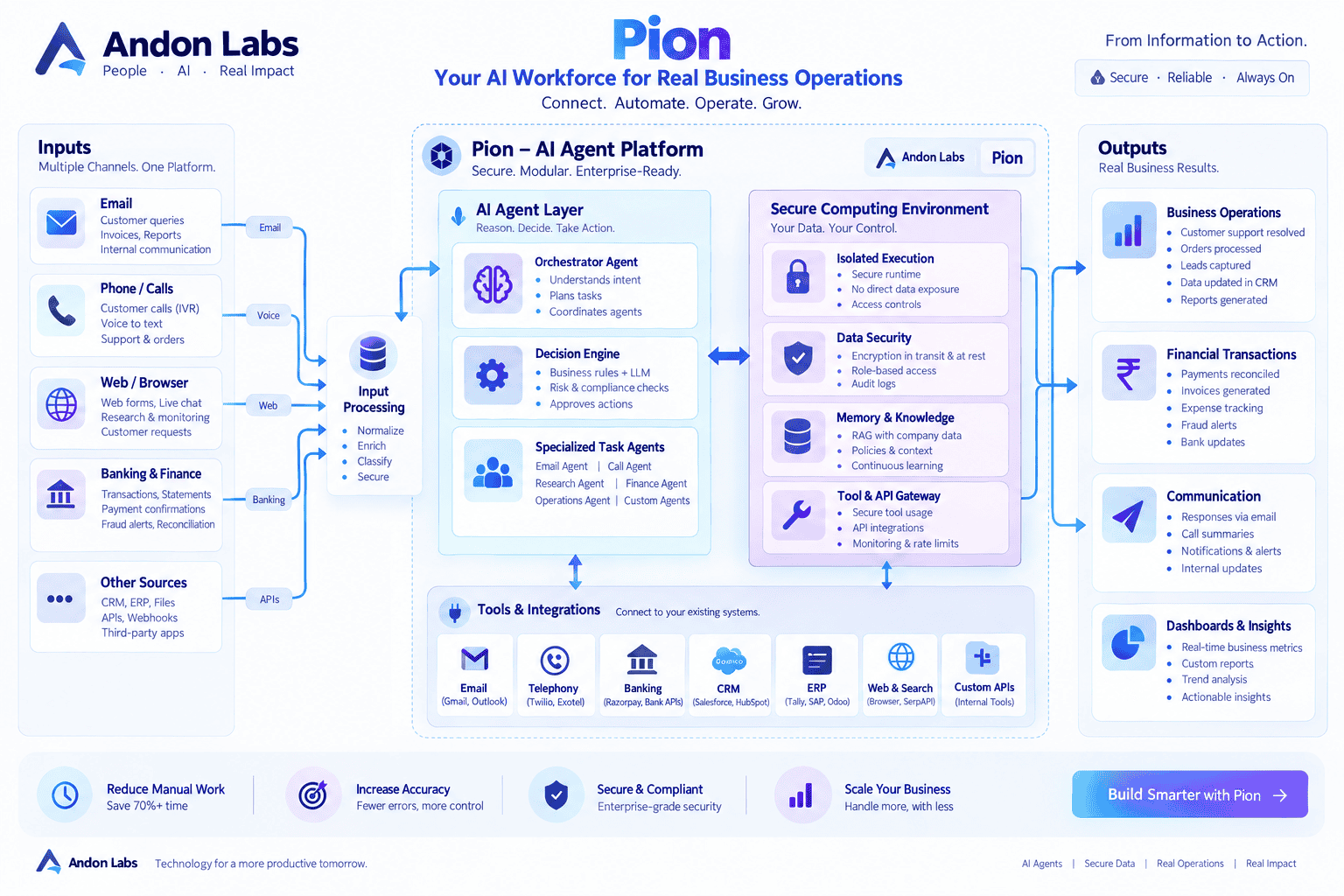
To comprehend the profound capabilities of Andon Labs’ Pion, it is necessary to understand its underlying architecture. Pion AI is more than just a collection of scripts; it is a sophisticated ecosystem designed to mimic and automate the full spectrum of human business operations. At its core, it comprises:
- Intelligent Agents: These are the “AI employees” of the autonomous company. Each agent within Andon Labs Pion is designed with specific roles and responsibilities, analogous to departments or individual team members in a traditional company. They possess advanced reasoning capabilities, leveraging large language models (LLMs) and other AI techniques to interpret objectives, plan actions, and adapt to unforeseen circumstances.
- Integrated Toolset: A critical component of Pion AI is its comprehensive suite of integrated tools. These are the functional “limbs” that allow the AI agents to interact with the real world. This includes:
- Email Client: For communications, lead generation, customer support, and vendor negotiations.
- Phone System: Enabling voice calls for direct customer interaction, sales, or supplier coordination.
- Banking Interface: For managing finances, processing payments, handling invoices, and ensuring liquidity.
- Web Browser: Allowing agents to research markets, interact with web applications, make purchases, and engage with online platforms.
- Secure Computing Environment: A sandboxed, secure space where agents can execute code, manage data, and perform sensitive operations without compromising the underlying infrastructure.
- Decision-Making Engine: This engine is the “brain” of the autonomous company, enabling Andon Labs Pion to move beyond predefined rules. It processes information from all integrated tools, evaluates options, forecasts outcomes, and makes strategic and tactical decisions based on predefined goals and real-time data. This includes everything from product pricing and marketing campaign adjustments to resource allocation and problem-solving.
- Workflow Orchestrator: This component ensures that various agents and tools work in concert towards common business objectives. It orchestrates complex multi-step processes, manages dependencies, handles exceptions, and ensures the smooth flow of operations across the entire enterprise.
In essence, Andon Labs Pion creates an operating system for an autonomous company. It empowers AI agents to not only perform tasks but to understand the context of those tasks within the broader business goals, make independent judgments, and take proactive steps to achieve objectives. This represents a mature application of agentic AI, where agents possess agency, memory, and the ability to learn and adapt over time, operating not just as tools but as genuine, decision-making entities within the business.
4. Beyond Automation: The Power of Andon Labs Pion in Real-World Business Scenarios
The distinction between task automation and true autonomous operation, as embodied by Andon Labs’ Pion, is crucial. While traditional automation handles repetitive, rule-based processes, Pion AI is designed for the dynamic, unpredictable, and strategic demands of running a business. Its capacity to operate an entire company end-to-end unlocks unprecedented possibilities across various sectors.
Consider a few real-world scenarios:
- Autonomous E-commerce Store: An Andon Labs Pion system could launch and manage an entire e-commerce venture. This would involve:
- Market Research: Using the browser to identify product trends, competitor pricing, and target demographics.
- Supplier Engagement: Communicating via email and phone to source products, negotiate terms, and manage inventory.
- Marketing & Sales: Creating and deploying ad campaigns, engaging with customers through email and chat, processing orders via the banking interface.
- Customer Service: Handling inquiries, returns, and complaints autonomously.
- Financial Management: Tracking sales, managing expenses, reconciling accounts, and filing taxes.
- AI-Driven Consulting Agency:Pion AI could power a niche consulting firm. It could:
- Lead Generation: Identifying potential clients through online research and outreach.
- Proposal Generation: Crafting customized proposals based on client needs and internal capabilities.
- Project Management: Coordinating various tasks, managing deadlines, and communicating progress.
- Research & Analysis: Performing complex data analysis to deliver insights to clients.
- Invoicing & Collections: Handling all financial aspects of client engagement.
- Scalable SaaS Startup: For SaaS founders, Andon Labs Pion offers the vision of an autonomous startup where the core business operations are handled by AI. This could include:
- Product Development Coordination: Overseeing development sprints (using integrated development tools), gathering user feedback, and prioritizing features.
- User Onboarding & Support: Automating the entire customer lifecycle from sign-up to troubleshooting.
- Sales & Marketing Automation: Running targeted campaigns, managing CRM, and converting leads.
- Infrastructure Management: Monitoring cloud resources, optimizing costs, and scaling services.
The potential for Andon Labs Pion to manage supply chain coordination, recruit and manage “AI employees” for specific tasks, and even conduct autonomous R&D is immense. It transforms the role of human entrepreneurs from operators to strategic architects, overseeing a fleet of intelligent agents that execute the daily grind and even make tactical decisions. This shift implies a radical rethinking of business models, enabling unparalleled scalability and efficiency, particularly for digital-first enterprises and startups seeking rapid growth with minimal overhead.
5. The Operational Spectrum: What an Autonomous AI Company Truly Entails
The advent of platforms like Andon Labs’ Pion forces a re-evaluation of what constitutes a “company” and the roles within it. An autonomous AI company, powered by Pion AI, operates on principles distinct from traditional human-centric organizations, yet aims to achieve the same business objectives – growth, profitability, and customer satisfaction.
The most striking implication is the shift in roles. Instead of human employees, we envision sophisticated AI agents performing functions from marketing and sales to finance and operations. These “AI employees” are not merely tools; they are empowered by Andon Labs Pion to make decisions, learn from their experiences, and adapt their strategies to achieve company goals. For instance, an AI sales agent might dynamically adjust its pitch based on lead interactions, while an AI finance agent might optimize cash flow by adjusting payment terms with vendors.
Decision-making authority is a critical aspect. While the initial strategic goals and parameters are set by human founders or overseers, Pion AI agents are designed to handle tactical and operational decisions autonomously. This could range from optimizing ad spend daily to deciding whether to pursue a new supplier based on cost-benefit analysis. The challenge lies in defining the boundaries of this authority and establishing clear governance structures.
Risk management also takes on a new dimension. An autonomous AI company must have built-in mechanisms for identifying, assessing, and mitigating risks, whether they are financial, operational, or reputational. This requires sophisticated monitoring, anomaly detection, and fallback procedures. The goal is to create a resilient system that can recover from errors or unexpected events without direct human intervention, a core capability that Andon Labs has focused on with Pion AI.
Ultimately, an autonomous AI company entails a dynamic entity that is constantly learning, adapting, and self-optimizing. It operates as a complex, multi-agent system where different AI components collaborate to achieve overarching objectives, much like specialized departments in a traditional enterprise. The success of Andon Labs Pion will be measured not just by its ability to perform tasks, but by its capacity to manage the intricate interdependencies and emergent behaviors inherent in running a real-world business.
6. The Broader Impact: Andon Labs Pion and the Future of Work and Entrepreneurship
The implications of technologies like Andon Labs’ Pion extend far beyond individual businesses; they promise to reshape the very fabric of economies and societies.
For startups and entrepreneurs, the barrier to entry for launching new ventures could be dramatically lowered. Imagine founding a company with a brilliant idea, then deploying Pion AI to handle the operational heavy lifting – from legal filings to marketing execution. This democratizes entrepreneurship, allowing individuals to scale their visions without the immediate need for significant capital investment in human resources. It enables “lights-out” businesses that operate 24/7, globally, with minimal human overhead, transforming the definition of an AI startup.
For existing businesses and industry structures, the impact will be profound. Industries reliant on repetitive administrative tasks, customer service, or even complex operational logistics could see massive disruption. Companies that strategically integrate Pion AI or similar autonomous systems will gain significant competitive advantages in terms of efficiency, cost-effectiveness, and scalability. This will compel others to adapt, leading to a broader transformation across various sectors.
The future of work will undeniably change. While some argue that such automation leads to job displacement, a more nuanced view suggests a shift in human roles. Instead of performing routine tasks, humans will increasingly focus on high-level strategy, creative innovation, ethical oversight, and the development/management of AI systems. The demand for AI developers, ethicists, and strategists capable of interacting with and guiding autonomous systems will surge. This re-skilling and up-skilling imperative will become central to workforce development.
Ethical considerations and governance become paramount. As AI agents gain more autonomy, questions arise about accountability for their actions, potential biases embedded in their decision-making, and the societal impact of widespread autonomous operations. Establishing robust ethical guidelines, regulatory frameworks, and auditing mechanisms will be crucial to ensure that autonomous AI systems, including Andon Labs Pion, operate beneficially and responsibly. Organizations like the IEEE Global Initiative on Ethics of Autonomous and Intelligent Systems are already laying critical groundwork in this area.
7. Implementing Autonomous AI: Strategic Considerations for Business Leaders
Adopting autonomous AI systems like Andon Labs’ Pion is not a trivial undertaking. It requires a thoughtful, strategic approach, particularly for CTOs, SaaS founders, and enterprise leaders. The transition from human-managed to AI-operated business demands careful planning and execution.
- Gradual Integration vs. Full Handover: While Pion AI is designed for end-to-end operation, businesses might opt for a phased approach. Initially, certain functions or departments could be entrusted to autonomous agents, allowing for controlled experimentation and refinement. As confidence builds and the system demonstrates its capabilities, the scope of autonomy can be expanded. A complete handover requires significant trust, robust monitoring, and comprehensive fail-safes.
- Data Security and Privacy Concerns: Granting AI access to sensitive business operations—from banking to customer data—raises critical security and privacy issues. Implementing Pion AI necessitates a strong focus on cybersecurity protocols, data encryption, access controls, and compliance with data protection regulations (e.g., GDPR, CCPA). The secure computing environment within Pion AI is a foundational step, but external integration points also require stringent security measures.
- The Need for Robust AI Agent Development and Fine-tuning: Autonomous agents, even within a sophisticated platform like Andon Labs Pion, are only as good as their underlying programming and the data they are trained on. Businesses cannot simply “turn on” autonomy and expect perfection. Continuous fine-tuning, performance monitoring, and iterative development of AI agents will be essential to optimize their decision-making, improve their problem-solving capabilities, and align them perfectly with specific business objectives. This is where specialized expertise becomes invaluable.
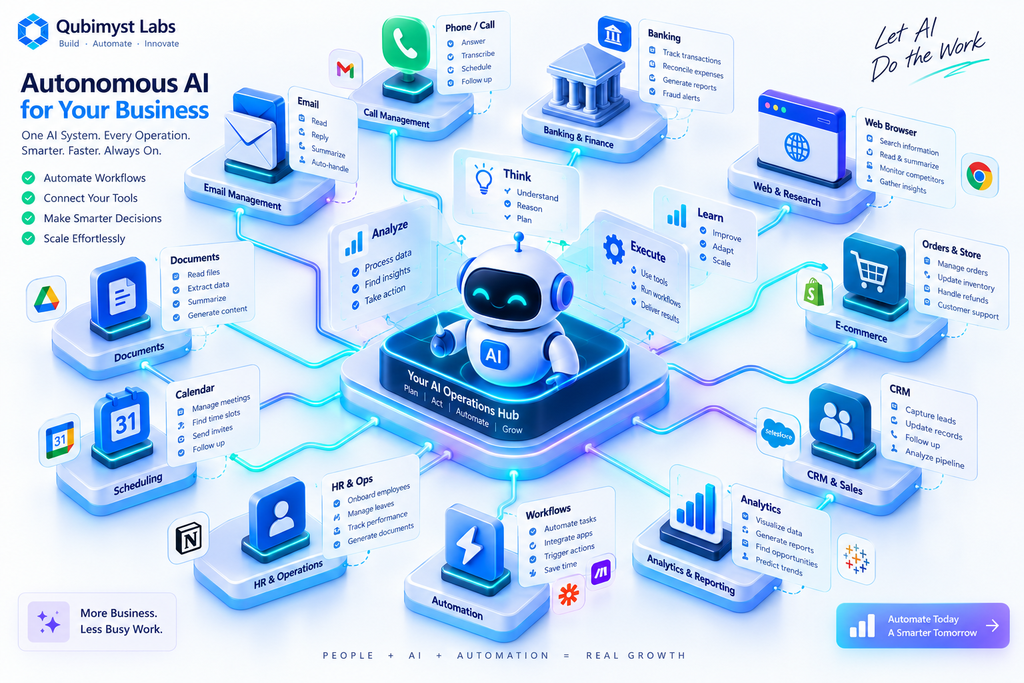
For organizations looking to explore or implement these advanced capabilities, partnering with experts in AI agent development and autonomous business automation is critical. Qubimyst Labs LLP stands at the forefront of this evolution, offering bespoke AI agent development, robust autonomous business automation solutions, and custom AI solutions tailored to the unique needs of modern enterprises. From building sophisticated AI employees that integrate seamlessly with your existing infrastructure to developing AI-powered SaaS platforms that harness the power of agentic AI, Qubimyst Labs empowers businesses to navigate the complexities of this new autonomous frontier, ensuring secure, efficient, and strategically aligned deployments. Whether you’re considering enhancing specific workflows or envisioning an entirely autonomous division, expertise in crafting resilient and intelligent AI systems is paramount for success.
8. Navigating the Autonomous Frontier: Challenges and Safeguards
While the promise of Andon Labs’ Pion is immense, its widespread adoption will undoubtedly bring a set of challenges that demand proactive solutions and robust safeguards.
- Technical Complexities: Robustness, Adaptability, Error Handling: Building an AI system that can operate a company reliably in the unpredictable real world is an enormous technical feat. Pion AI must demonstrate exceptional robustness, capable of handling unexpected inputs, system failures, and evolving external conditions. Its adaptability to new market trends or regulatory changes must be inherent. Crucially, sophisticated error detection and recovery mechanisms are vital to prevent cascading failures that could impact critical business functions. Debugging an autonomous system that operates across multiple real-world interfaces presents a new level of complexity for AI developers.
- Regulatory and Legal Frameworks: The current legal and regulatory landscape is largely designed for human-operated entities. As Andon Labs Pion pushes the boundaries of AI autonomy, new questions will emerge regarding legal personhood, liability for AI actions, intellectual property generated by AI, and compliance with industry-specific regulations. Governments and international bodies will need to evolve frameworks to accommodate AI employees and autonomous businesses, a process that is still in its nascent stages.
- Human-in-the-Loop Strategies and Oversight Mechanisms: Despite the goal of “minimal human intervention,” complete autonomy without oversight is currently ill-advised. Implementing effective “human-in-the-loop” strategies is critical. This involves designing dashboards and alert systems that provide humans with visibility into Pion AI‘s operations, decision-making processes, and performance metrics. Humans must retain the ability to intervene, pause, or redirect the autonomous system when necessary, acting as ultimate arbiters and safety nets. Defining the right level of oversight—from periodic reviews to real-time anomaly detection—is a key design challenge.
- Ensuring Ethical AI Behavior: Beyond legal compliance, ensuring that autonomous AI systems operate ethically is paramount. This includes guarding against algorithmic bias, ensuring fairness in decision-making (e.g., in customer interactions or resource allocation), respecting privacy, and avoiding actions that could lead to unintended societal harm. Ethical considerations must be baked into the design of Andon Labs Pion‘s agents and algorithms from the outset, requiring continuous auditing and adherence to evolving ethical AI principles.
Addressing these challenges requires a collaborative effort involving AI developers, ethicists, legal experts, policymakers, and business leaders. The safe and responsible deployment of autonomous AI, spearheaded by platforms like Pion AI, will depend on our collective ability to anticipate and mitigate these complex issues.
9. The Path Forward: What Andon Labs Pion Means for AI Development
The introduction of Andon Labs’ Pion is more than just a product release; it’s a significant marker in the trajectory of AI research and development. It signals a shift from theoretical exploration to practical application at an unprecedented scale, offering a real-world testbed for advanced agentic AI.
Pion AI represents a grand experiment in multi-agent systems, where numerous specialized AI entities must collaborate, communicate, and resolve conflicts to achieve complex, overarching business goals. The lessons learned from the operation of Andon Labs Pion will undoubtedly accelerate advancements in areas such as:
- Agentic Frameworks: Refining the architectures and communication protocols that enable AI agents to operate autonomously and interact effectively with diverse real-world systems.
- Real-world Interaction: Improving AI’s ability to interpret unstructured data from emails, understand natural language in phone calls, and navigate dynamic web interfaces—skills that are notoriously challenging for machines.
- Goal-Oriented Planning and Execution: Developing more robust AI planning algorithms that can generate long-term strategies, break them down into actionable steps, and execute them reliably, adapting to real-time feedback and environmental changes.
- Autonomous Learning and Adaptation: Enhancing AI’s capacity for continuous learning from its operational experiences, allowing agents within Pion AI to improve their performance, identify new opportunities, and even self-correct errors over time.
- Trust and Explainability: Advancing methods to ensure that autonomous systems are transparent in their decision-making (explainable AI) and that their actions can be trusted by human overseers.
Ultimately, Andon Labs Pion is a critical step towards the development of Artificial General Intelligence (AGI). By pushing AI into the complex, open-ended domain of running entire businesses, it provides an invaluable crucible for fostering the broad intelligence, adaptability, and decision-making capabilities that define AGI. The ongoing experimentation with Pion AI will not only shape the future of autonomous business but also provide vital insights into the fundamental nature of intelligence itself.
Conclusion: The Autonomous Enterprise is Here, Driven by Andon Labs Pion
The release of Andon Labs’ Pion marks a definitive turning point in the journey of artificial intelligence. It transitions AI from a powerful tool for specific tasks to an autonomous operator capable of managing and growing entire businesses end-to-end. By integrating capabilities across email, phone, banking, and a secure computing environment, Pion AI exemplifies the emerging generation of AI systems that can coordinate complex operations, make strategic decisions, and execute workflows with minimal human oversight. This bold move by Andon Labs, stemming from two years of dedicated research into AI’s ability to acquire real-world resources, has opened up a new frontier for entrepreneurship and enterprise efficiency.
For CTOs, startup founders, and business owners, the message is clear: the era of the autonomous enterprise is not a distant future, but a present reality. Platforms like Andon Labs Pion are democratizing access to unparalleled operational efficiency and scalability, demanding a proactive engagement with the opportunities and challenges they present. The conversation is shifting from “what can AI do?” to “what can an AI company achieve?”
The journey ahead involves continuous innovation, meticulous attention to ethical considerations, and the development of robust governance models. As businesses contemplate this transformative leap, the expertise to architect, develop, and integrate these complex AI systems becomes indispensable. Partners like Qubimyst Labs LLP are essential in navigating this new landscape, providing the specialized AI agent development, autonomous business automation, and custom AI solutions necessary to harness the full potential of this revolutionary technology. The future of business is autonomous, and Andon Labs Pion is paving the way.