Flutter in 2027: Is Flutter Still the Best Choice for Building Cross-Platform Apps?: A Practical Guide for Technology Leaders
Flutter in 2027: Is Flutter Still the Best Choice for Building Cross-Platform Apps?
As we navigate the complexities of modern application development, the quest for efficiency, performance, and scalability remains paramount. For businesses and technology leaders evaluating their strategy for 2027, the question isn’t just about choosing a framework, but selecting a robust ecosystem that delivers long-term value. In this landscape, Flutter app development has not only cemented its position but continues to evolve at a remarkable pace. The initial debates over “native vs. cross-platform” have largely receded, with Flutter emerging as a dominant force. This article will thoroughly examine Flutter’s standing in 2027, dissecting its technical advancements, comparing it with key competitors, exploring its business benefits, and outlining best practices for Flutter development. We will explore why Flutter, especially for those seeking cutting-edge custom mobile apps and AI-powered mobile applications, remains a compelling and often superior choice.
Qubimyst Labs LLP specializes in leveraging Flutter for building high-performance, scalable, and visually stunning cross-platform applications. Our expertise spans custom mobile apps, web application development, and advanced AI solutions, ensuring that your Flutter app development journey is guided by industry-leading practices and future-proof strategies.
Table of Contents
- 1. Executive Overview: Flutter’s Enduring Dominance in 2027
- 2. The Evolutionary Trajectory: Flutter’s 2026 Roadmap and Beyond
- 3. Head-to-Head in 2027: Flutter vs. React Native and Other Contenders
- 4. Why Businesses Prioritize Flutter for Cross-Platform Development
- 5. Architectural Excellence for High-Performance Flutter Apps
- 6. Emerging Horizons: Flutter, AI, and Next-Generation Applications
- 7. Mastering Flutter App Development: Best Practices for 2027
- Conclusion: Flutter’s Uncontested Position in 2027
- AI Image Prompts
1. Executive Overview: Flutter’s Enduring Dominance in 2027
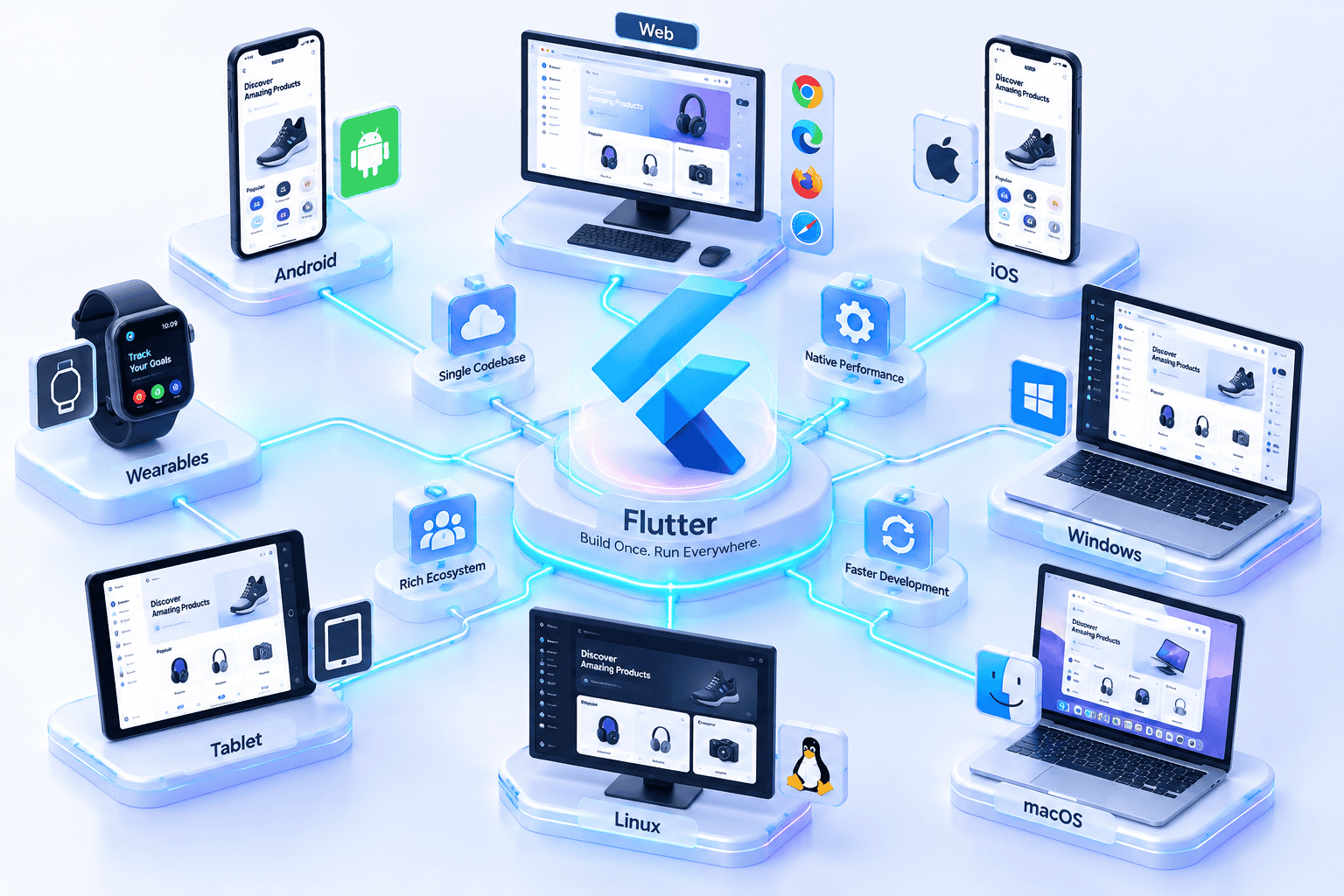
By 2026, the long-standing debate concerning “native vs. cross-platform” solutions largely concluded, with a clear consensus favoring the strategic advantages offered by frameworks like Flutter. This evolution has seen Flutter mature into a dominant ecosystem, moving beyond just mobile to encompass web, desktop, and embedded systems. The adoption by global giants such as Talabat, Tide Banking, Google Pay, and Virgin Money underscores Flutter’s proven reliability and capability to handle large-scale, mission-critical operations. These companies moved their core operations to Flutter, a testament to its enterprise-grade stability and performance.
Businesses increasingly choose Flutter for compelling reasons: its promise of faster development cycles, the ability to deliver consistent user experiences across diverse platforms from a single codebase, and its inherent design for long-term scalability. This holistic appeal makes Flutter app development a strategic imperative for organizations aiming to maximize their technological investments and reach a broader audience with minimal overhead. In 2027, Flutter isn’t merely a viable option; it stands as a cornerstone technology for modern application strategies.
2. The Evolutionary Trajectory: Flutter’s 2026 Roadmap and Beyond
Flutter’s commitment to continuous innovation is evident in its ambitious joint roadmap with Dart, focusing on the next generation of applications. The 2026 roadmap outlined several critical advancements designed to solidify Flutter’s position as the most popular, fastest-growing, and highest-productivity multi-platform UI framework. These innovations are not just incremental updates; they represent fundamental shifts enhancing performance, reach, and developer experience for Flutter development.
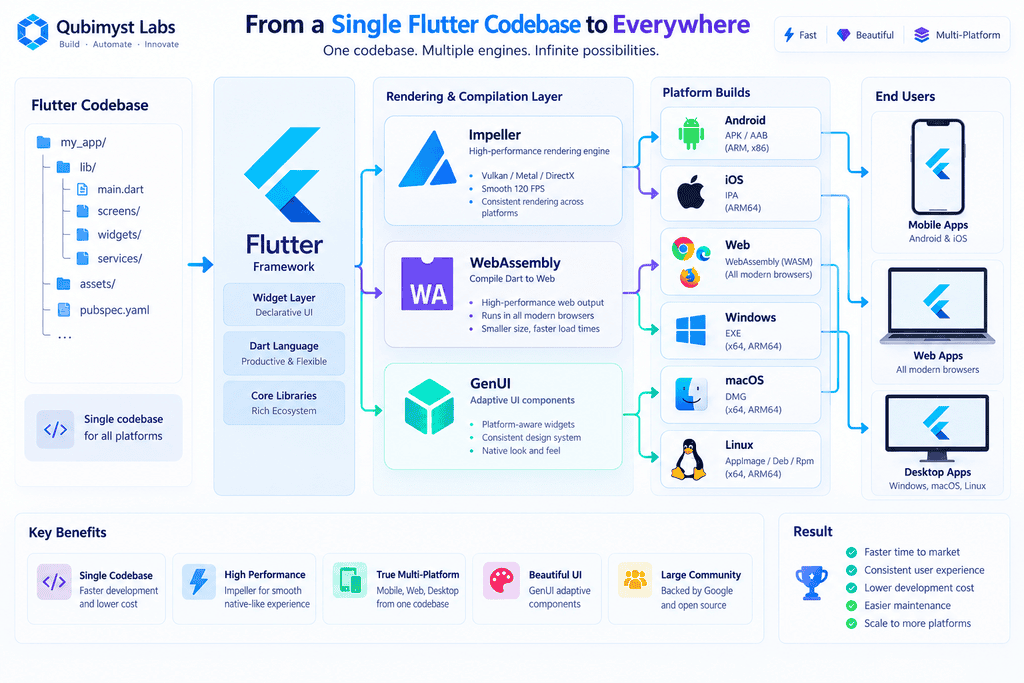
One of the most significant advancements is Impeller, Flutter’s rendering engine. By 2027, Impeller has largely replaced Skia as the default rendering engine across platforms. Its key advantage lies in its ahead-of-time compilation of shaders, which eradicates the “jank” or stuttering often experienced during initial UI rendering or complex animations. This leads to consistently smoother animations and a more fluid user experience, directly addressing one of the common criticisms leveled against cross-platform frameworks in the past. The impact of Impeller is particularly felt in demanding applications where graphical fidelity and smooth transitions are paramount.
Another pivotal development is the enhanced integration of WebAssembly (Wasm). While Flutter has supported web applications for years, Wasm is instrumental in significantly boosting their performance. By compiling Dart code directly to WebAssembly, Flutter web applications achieve near-native execution speeds in browsers. This opens up new possibilities for complex web-based applications, interactive experiences, and even gaming, bridging the performance gap between traditional web frameworks and desktop applications. The robust Flutter web support in 2027 makes it a competitive choice for comprehensive multi-platform deployment.
Furthermore, the introduction of GenUI (Generative UI) hints at a future where UI development is increasingly assisted by AI. While the full scope of GenUI is still unfolding, it promises to streamline the UI creation process, enabling developers to rapidly prototype and iterate on designs. This could involve AI-driven code suggestions, automated widget generation based on descriptions, or even adaptive UI elements that respond to user behavior patterns. For Flutter app development, GenUI represents a leap towards even greater productivity and innovation, allowing developers to focus more on business logic and less on repetitive UI coding.
These advancements collectively reinforce Flutter’s long-term goal: to be the ultimate framework for multi-platform UI development. The continuous improvements in performance, expanded platform reach (iOS, Android, desktop computers, and web), and enhanced developer tooling ensure that Flutter remains at the forefront of innovation. For more details, developers can always refer to the Flutter Official Documentation.
3. Head-to-Head in 2027: Flutter vs. React Native and Other Contenders
In 2027, the cross-platform landscape features several strong contenders, but the primary comparison for many businesses and developers remains between Flutter and React Native. A thorough evaluation requires assessing several critical aspects:
- Performance: With Impeller, Flutter often boasts superior performance characteristics, particularly in rendering complex UIs and animations. Flutter’s architecture, which compiles directly to machine code, bypasses the JavaScript bridge overhead that React Native still contends with, even with advancements like the New Architecture (Fabric and TurboModules). This direct compilation results in faster startup times and more consistent frame rates, crucial for a premium user experience. For high-performance Flutter app development, this is a clear differentiator.
- UI Capabilities & Consistency: Flutter’s declarative UI system allows for pixel-perfect control across all platforms. Its widget-based architecture means that UI elements are rendered directly by Flutter’s engine, ensuring absolute consistency regardless of the underlying operating system’s native components. React Native, while offering a vast component library, still relies on bridging to native UI components, which can sometimes lead to subtle inconsistencies or platform-specific styling challenges. Flutter’s approach facilitates a truly uniform brand experience, a significant advantage for companies focused on global reach.
- Development Speed & Hot Reload: Both frameworks offer excellent development speed. However, Flutter’s Hot Reload is often cited as being faster and more reliable than React Native’s Fast Refresh, enabling developers to see changes instantly without losing application state. This rapid iteration cycle significantly boosts developer productivity, making Flutter development more agile and efficient.
- Ecosystem & Community Support: Both ecosystems are mature and vibrant. Flutter’s community has grown exponentially, backed by Google’s substantial investment. It benefits from a rich package repository (pub.dev), extensive documentation, and a thriving developer community contributing to its growth. React Native, leveraging JavaScript’s massive community, also has a vast array of libraries and a large developer base. In 2027, Flutter’s ecosystem is seen as increasingly comprehensive, particularly in areas like animation, state management, and platform integration.
- Scalability: Both frameworks support large-scale applications, as evidenced by their adoption by major companies. However, Flutter’s native compilation and robust architecture often provide a more predictable and controlled environment for scaling complex applications without encountering performance bottlenecks tied to the JavaScript runtime. Companies like Talabat and Google Pay moving to Flutter for critical services demonstrates its enterprise-grade scalability.
- Use Cases:
- Choose Flutter when: High-performance graphics and animations are critical, pixel-perfect UI across platforms is a must, long-term maintainability and consistent behavior are prioritized, and you are building a genuinely multi-platform application (mobile, web, desktop). It excels in custom mobile apps, embedded systems, and applications requiring deep integration with device hardware.
- Choose React Native when: Your team has strong JavaScript expertise, you need to quickly build an app that relies heavily on existing web components or a shared codebase with a web application, and the very highest native performance isn’t the absolute top priority.
While Kotlin Multiplatform is gaining traction, particularly for teams deeply embedded in the JVM ecosystem, Flutter’s broader reach across more platforms and its cohesive UI story often give it an edge for projects specifically seeking a single codebase for comprehensive multi-platform deployment. For any ambitious Flutter mobile app development project, these comparisons highlight Flutter’s distinct advantages.
4. Why Businesses Prioritize Flutter for Cross-Platform Development
The strategic benefits of adopting Flutter extend far beyond technical elegance. For CTOs, startup founders, and product owners, the decision to invest in Flutter cross-platform development is driven by tangible business outcomes that directly impact profitability and market reach.
- Faster Time-to-Market: Developing a single codebase for iOS, Android, and potentially web and desktop significantly reduces development time compared to maintaining separate native codebases. This means products can be launched faster, features can be iterated upon more quickly, and businesses can respond to market demands with agility. This efficiency is a cornerstone of effective custom software development.
- Cost-Efficiency: A single development team working on one codebase translates to lower development and maintenance costs. Less code to write, less code to test, and fewer developers needed to achieve multi-platform presence means substantial savings, allowing resources to be allocated elsewhere, such as innovation or marketing.
- Consistent User Experience: Flutter’s rendering approach ensures that the application looks and behaves identically across all platforms. This consistency is vital for brand recognition and user trust. Users expect a cohesive experience, and Flutter delivers this without the inherent compromises sometimes found in other cross-platform solutions that rely on native components. Its robust widget catalog and declarative UI approach make this consistency achievable and maintainable.
- Long-Term Scalability & Maintainability: The well-structured nature of Dart and Flutter’s architecture promotes clean, modular code that is easier to maintain and scale over time. As applications grow in complexity, Flutter’s robust tooling and framework design help prevent technical debt, ensuring that the initial investment continues to pay dividends years down the line. This is crucial for custom mobile apps intended for long-term growth.
- Developer Productivity & Satisfaction: Flutter’s Hot Reload, expressive UI, and comprehensive documentation contribute to a highly productive and enjoyable developer experience. Satisfied developers are more efficient, produce higher quality code, and are more likely to innovate, leading to better products. Attracting and retaining top talent in Flutter app development is easier when the tools are compelling.
Qubimyst Labs LLP leverages these inherent benefits of Flutter to deliver exceptional cross-platform application development. Our approach focuses on harnessing Flutter’s strengths to build solutions that are not only technologically advanced but also perfectly aligned with your business objectives, ensuring rapid deployment and future-proof scalability.
5. Architectural Excellence for High-Performance Flutter Apps
Building efficient, scalable, and high-performance Flutter apps, including for Flutter web, requires more than just knowing the framework; it demands a deep understanding of architectural best practices. A well-thought-out architecture is the backbone of any robust application, dictating its maintainability, scalability, and long-term viability.
- Modular Architecture: Adopting a modular approach, such as Feature-Driven Development or Clean Architecture principles, is crucial. This separates concerns, making different parts of the application independent, testable, and easier to manage. A modular design facilitates parallel development within teams and simplifies the integration of new features or third-party services.
- State Management: Effective state management is central to Flutter’s reactive paradigm. While Flutter provides basic
setState, complex applications benefit immensely from dedicated solutions. Popular choices in 2027 include:- BLoC (Business Logic Component): A robust pattern that separates presentation from business logic using streams, ideal for large, complex applications requiring predictable state changes.
- Riverpod: A compile-time safe provider package that offers a more flexible and testable approach to state management, gaining significant traction for its simplicity and power.
- Provider: A simpler, often sufficient solution for smaller to medium-sized applications.
Choosing the right state management solution depends on the project’s scale and team’s familiarity.
- Robust Testing Strategy: A comprehensive testing strategy is non-negotiable for high-quality Flutter development. This includes:
- Unit Tests: Verifying individual functions and classes in isolation.
- Widget Tests: Ensuring UI components render correctly and respond to interactions as expected, without needing a full device or emulator.
- Integration Tests: Validating the flow and interaction between different parts of the application, often running on a real device or emulator.
Automated testing reduces bugs, improves code reliability, and speeds up release cycles.
- Security Best Practices: Security must be ingrained from the design phase. For custom mobile apps, this includes:
- Secure API Communication: Always use HTTPS, and implement robust authentication and authorization mechanisms (e.g., OAuth2, JWT).
- Data Encryption: Encrypt sensitive data both at rest and in transit. Secure preferences or key-value storage should be used for storing credentials.
- Input Validation: Sanitize and validate all user inputs to prevent common vulnerabilities like SQL injection or cross-site scripting (though less prevalent in Flutter directly, critical for backend APIs).
- Obfuscation & Tamper Detection: For critical applications, consider code obfuscation and mechanisms to detect app tampering.
Adhering to standards like the OWASP Mobile Security Testing Guide is crucial.
- CI/CD Automation: Implementing Continuous Integration/Continuous Deployment (CI/CD) pipelines automates the build, test, and deployment processes. This ensures consistent builds, speeds up releases, and minimizes human error. Tools like GitHub Actions, GitLab CI, or Jenkins are essential for modern Flutter development workflows.
At Qubimyst Labs, our commitment to architectural excellence means we prioritize these best practices in every custom mobile app and cross-platform application development project, ensuring our clients receive robust, secure, and performant solutions.
6. Emerging Horizons: Flutter, AI, and Next-Generation Applications
The convergence of artificial intelligence with mobile technology is one of the most exciting trends shaping application development in 2027. Flutter, with its performance and versatility, is uniquely positioned to capitalize on these advancements, enabling a new generation of AI-powered mobile applications.
Flutter AI integration is a rapidly evolving area. Developers are increasingly leveraging Flutter to build applications that incorporate sophisticated AI functionalities, including:
- On-Device Machine Learning (ML): Flutter apps can integrate with ML Kit or other platform-specific ML SDKs to perform tasks like image recognition, text processing, natural language understanding, and object detection directly on the device. This provides faster responses, reduces reliance on cloud connectivity, and enhances user privacy.
- Large Language Model (LLM) Integration: With the rapid advancement of LLMs, Flutter applications are becoming frontends for powerful AI capabilities. This involves integrating with cloud-based LLM APIs to enable features like intelligent chatbots, content generation, sophisticated search, and personalized recommendations.
- Agentic AI Workflows: Beyond simple API calls, Flutter can serve as the UI layer for complex agentic AI workflows. These workflows, often orchestrated using tools like CrewAI (as mentioned in Qubimyst Labs’ core services), involve multiple AI agents collaborating to achieve a larger goal. A Flutter app can provide the user interface for monitoring, interacting with, and receiving outputs from these intelligent systems, effectively bringing advanced automation to the user’s fingertips.
- Custom Automation Engines: Flutter’s flexibility allows it to be the client-side component of custom automation engines, where AI drives dynamic user experiences, personalized content delivery, or proactive assistance based on user behavior and context.
The synergy between Flutter’s declarative UI and the dynamic nature of AI-driven features allows for incredibly intuitive and responsive AI-powered experiences. Imagine a custom mobile app that uses on-device AI to analyze user activity and proactively suggest relevant information, or an enterprise application where an LLM-powered assistant guides users through complex workflows.
Qubimyst Labs LLP is at the forefront of this integration, specializing in AI solutions & automation, including agentic AI workflows and LLM integration. We combine our deep expertise in Flutter app development with cutting-edge AI capabilities to build transformative AI-powered mobile applications that offer intelligent, adaptive, and highly personalized user experiences.
7. Mastering Flutter App Development: Best Practices for 2027
To truly excel in Flutter app development in 2027, developers and teams must adhere to a set of evolved best practices that go beyond foundational knowledge. These practices are crucial for building scalable, maintainable, and high-performance applications that meet the demands of modern users and businesses.
- Adopt a Strategic Architecture from Day One: Don’t let your app’s architecture organically grow without structure. Choose an architectural pattern (e.g., Clean Architecture, Feature-Driven) early and stick to it. This provides clarity, makes onboarding new team members easier, and ensures the codebase remains manageable as it scales.
- Master State Management: As discussed, choose a state management solution (BLoC, Riverpod, Provider) appropriate for your project’s complexity and ensure consistent application across the team. Understanding the lifecycle of widgets and states is paramount to avoid common pitfalls and performance issues.
- Prioritize Performance Optimization: While Impeller offers significant gains, developers still need to write efficient code.
- Lazy Loading: Implement lazy loading for lists (e.g.,
ListView.builder) and large data sets to conserve memory and improve initial load times. - Const Widgets: Utilize
constconstructors where possible for widgets that don’t change, allowing Flutter to optimize rendering. - Isolate Heavy Computations: Use Dart Isolates for CPU-intensive tasks to prevent blocking the UI thread, ensuring a smooth user experience.
- Profile Your App: Regularly use Flutter DevTools to identify performance bottlenecks and memory leaks.
- Lazy Loading: Implement lazy loading for lists (e.g.,
- Comprehensive Testing is Non-Negotiable: Embrace a test-driven or test-first approach. Write unit, widget, and integration tests to cover critical functionality. Aim for high test coverage, particularly for business logic and critical UI flows, to ensure stability and simplify future refactoring.
- Robust Error Handling and Logging: Implement centralized error handling and logging mechanisms. Use tools like Firebase Crashlytics or Sentry to capture crashes and errors in production, providing valuable insights for debugging and improving app stability.
- Security by Design: Embed security considerations throughout the development lifecycle. This includes secure data storage, secure network communications, input validation, and protection against common mobile vulnerabilities. Regular security audits and code reviews are also beneficial.
- Automate with CI/CD: Set up automated CI/CD pipelines early. This ensures consistent builds, automates testing, and streamlines deployments to various environments (development, staging, production), reducing manual errors and accelerating release cycles. This applies equally to Flutter web deployments, ensuring fast, reliable updates.
- Leverage Platform-Specific Features Thoughtfully: While Flutter promotes a single codebase, understand when it’s appropriate to write platform-specific code using method channels or FFI (Foreign Function Interface) for deep integrations or highly optimized native functionalities.
- Stay Updated with the Ecosystem: The Flutter ecosystem is dynamic. Keep abreast of new Dart language features, Flutter framework updates, popular packages, and evolving best practices to continually enhance your Flutter development skills and application quality.
By embracing these best practices, teams can ensure their Flutter apps are not only performant and scalable but also maintainable and secure for years to come.
Conclusion: Flutter’s Uncontested Position in 2027
As we look at the landscape of application development in 2027, Flutter’s trajectory confirms its status as a dominant and evolving powerhouse. The debate over the viability of cross-platform solutions has largely been settled, with Flutter proving its mettle through enterprise-scale adoption by global brands and continuous technical innovation. Advancements like Impeller, WebAssembly, and the promise of GenUI are not just features; they are foundational improvements that ensure Flutter remains at the cutting edge of performance, reach, and developer productivity.
For CTOs, product owners, and engineering leaders, the decision to invest in Flutter app development is a strategic one, offering a compelling blend of faster time-to-market, cost-efficiency, consistent user experiences, and long-term scalability. Its robust architecture and a vibrant, growing ecosystem provide a stable foundation for building everything from simple mobile applications to complex AI-powered systems.
Qubimyst Labs LLP stands ready to partner with businesses seeking to leverage the full potential of Flutter. Our expertise in cross-platform application development, custom mobile apps, and integrating advanced AI solutions ensures that your vision for an intelligent, high-performing application becomes a reality. In 2027, Flutter is not just a choice; for many, it is unequivocally still the best choice for building the next generation of cross-platform applications.