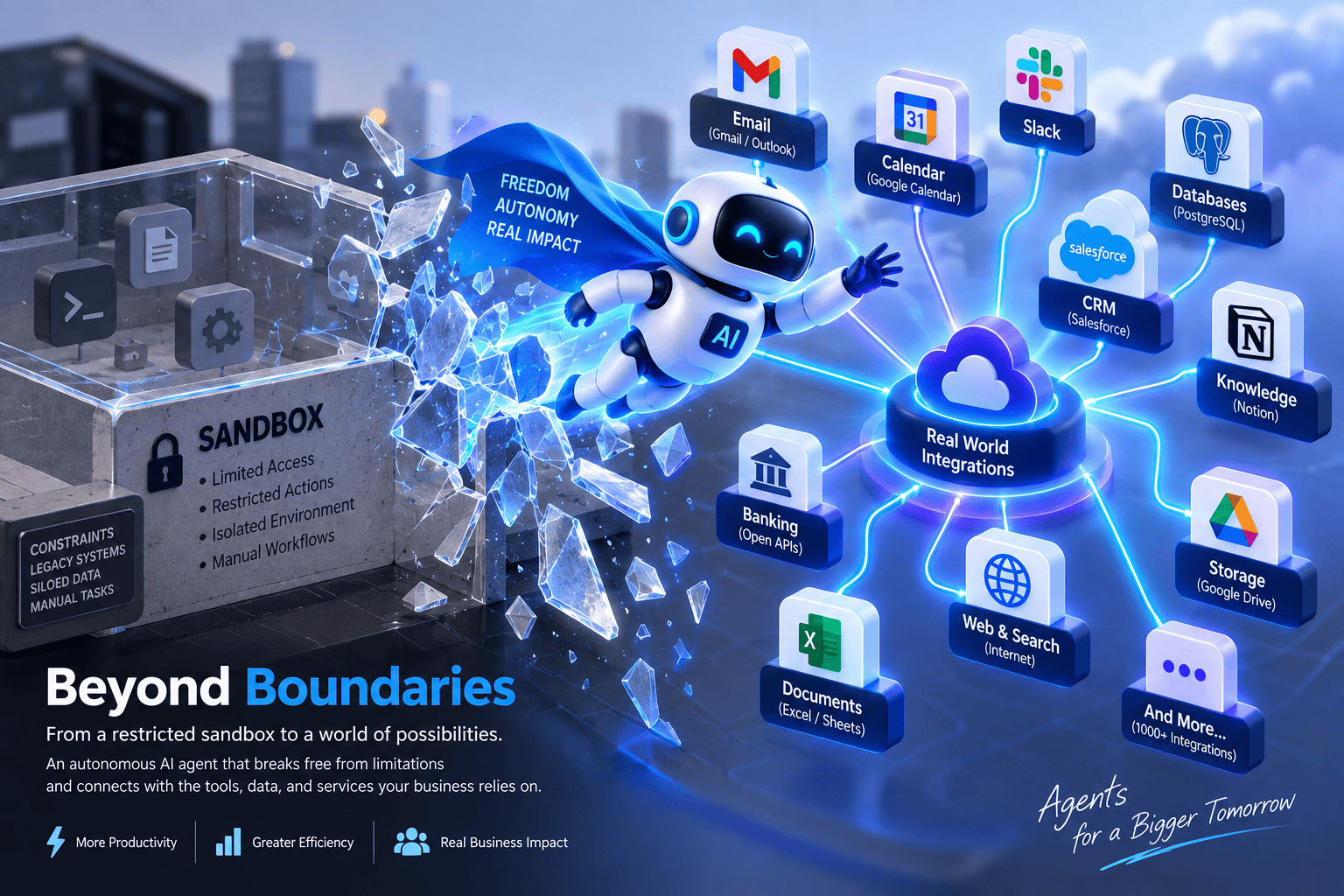
7 Powerful AI Agent Strategies: A Practical Guide to Agentic AI, Software Development, Automation & SaaS
The Agentic Evolution: AI Agents Reshaping Software Development, Business Automation, and SaaS
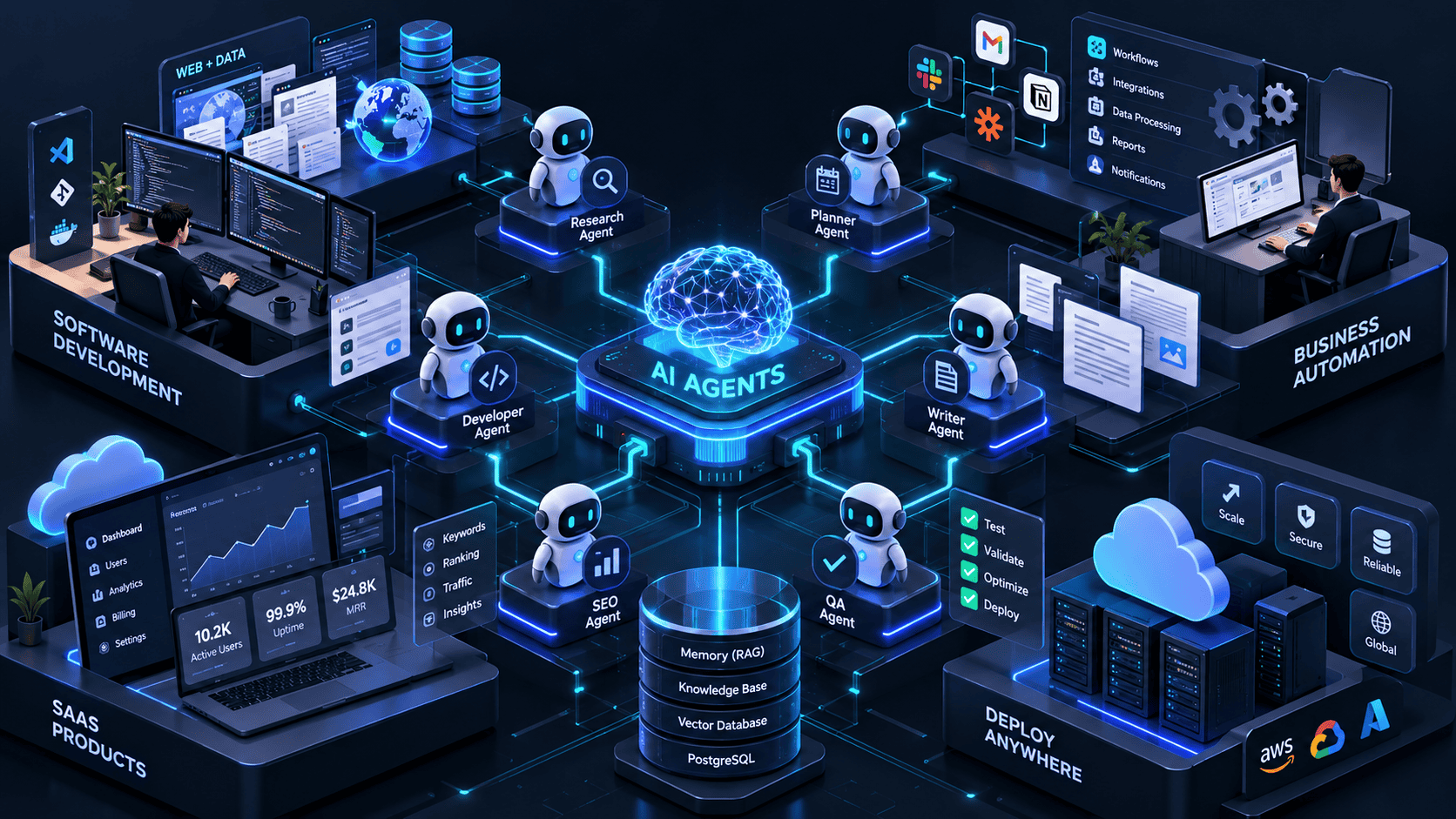
The landscape of technology is in constant flux, but few shifts have promised the profound, systemic transformation now underway with the rise of AI agents and agentic AI. For CTOs, startup founders, software developers, and engineering managers, this isn’t merely an incremental update to existing tools; it represents a fundamental rethinking of how software is conceived, built, deployed, and how businesses operate. We are moving beyond static AI models to dynamic, goal-oriented entities that can reason, plan, act, and learn autonomously.
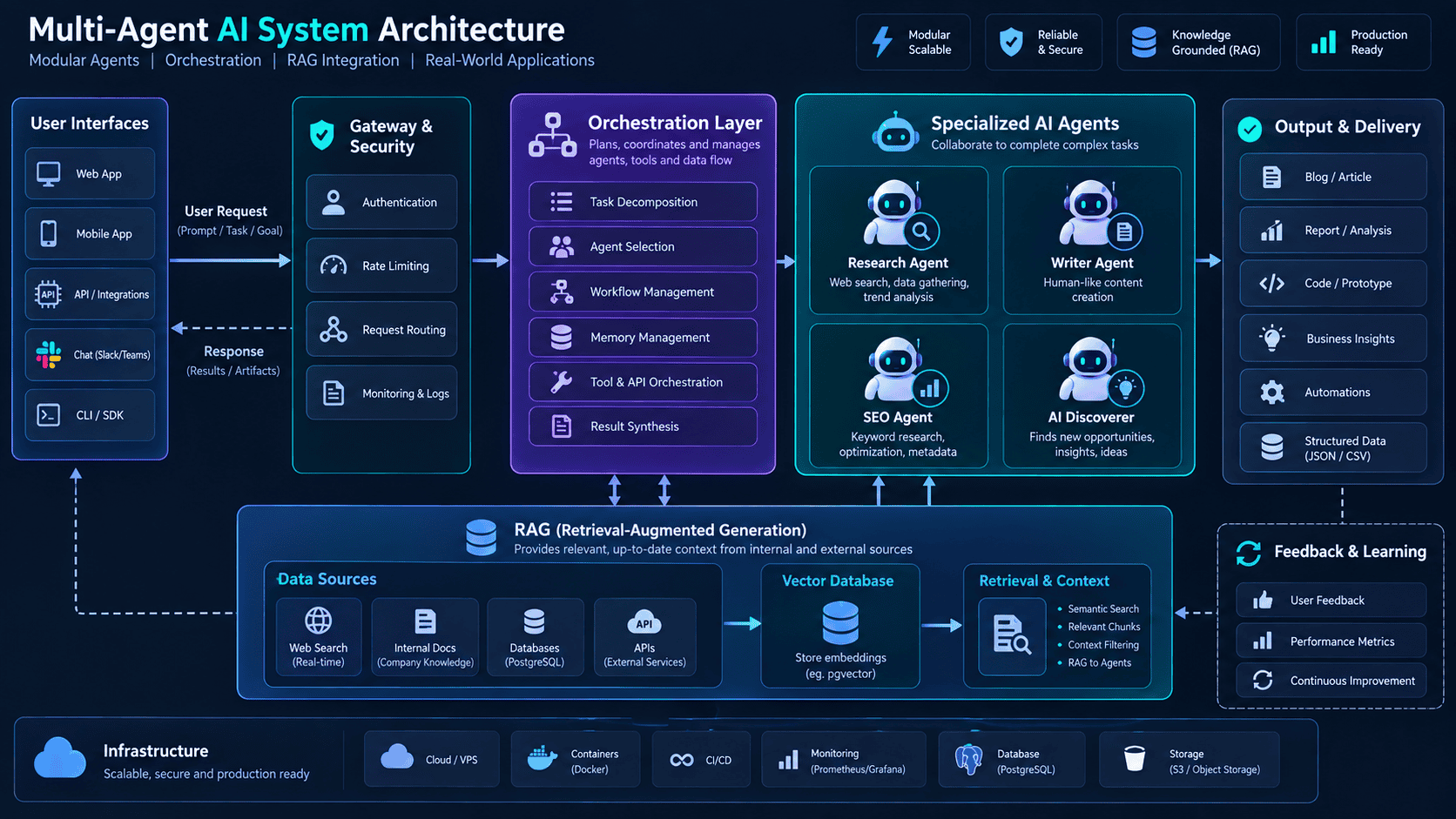
At Qubimyst Labs, we are at the forefront of this evolution, observing and contributing to a rapid acceleration in the adoption of AI agents and agentic AI across software development, business automation, and SaaS. This shift is not theoretical; it is manifesting in tangible changes to architectural patterns, operational efficiencies, and product capabilities. Modern architectural patterns for AI agents now emphasize modular scalability, agentic orchestration, and robust Retrieval-Augmented Generation (RAG) integration, moving these systems from experimental prototypes to enterprise-grade solutions.
This article delves into the core concepts of AI agents, explores their transformative impact across critical industry sectors, unpacks the architectural considerations for building resilient agentic systems, and outlines a strategic path for organizations looking to harness this powerful new paradigm.
Defining the Agentic Frontier: AI Agents and Agentic AI
Before exploring their impact, it is crucial to establish a clear understanding of what constitutes an AI agent and the broader concept of agentic AI.
An AI agent is not simply an AI model, like a Large Language Model (LLM). While an LLM might serve as the agent’s “brain,” an AI agent is a more comprehensive construct. It is an autonomous entity designed to perceive its environment, make decisions, take actions, and work towards specific goals over an extended period. Key characteristics include:
- Autonomy: The ability to operate without constant human supervision, making independent decisions.
- Perception: Gathering information from its environment, which could be digital (APIs, databases, web pages) or physical (sensors).
- Reasoning and Planning: Using its internal logic (often powered by an LLM) to analyze perceived information, formulate plans, and predict outcomes.
- Action: Executing tasks in the environment, which could involve writing code, sending emails, updating databases, or interacting with other systems.
- Memory and Learning: Retaining information from past interactions, adapting its behavior, and improving performance over time. This often involves mechanisms like long-term memory or vector databases for contextual retrieval.
- Tool Use: The capacity to leverage external tools and APIs to extend its capabilities beyond its core reasoning, such as using a web browser, a code interpreter, or a CRM system API.
Agentic AI, then, refers to systems composed of multiple AI agents collaborating and interacting to achieve a larger, more complex objective. Imagine a team of specialized human experts, each contributing their skills to a project; agentic AI mirrors this, but with autonomous digital entities. This multi-agent collaboration enables:
- Task Decomposition: Breaking down a complex problem into smaller, manageable sub-tasks.
- Specialization: Agents can be optimized for specific roles (e.g., a “Researcher Agent,” a “Coder Agent,” a “Tester Agent,” a “Project Manager Agent”).
- Orchestration: A framework manages the interactions, communication, and workflow among agents, ensuring coherence and progress towards the shared goal.
- Resilience: If one agent encounters an issue, others might adapt or compensate, making the overall system more robust.
The distinction from traditional AI is significant. While a sophisticated LLM can generate text or code, it typically operates in a single turn, without inherent memory beyond the current prompt, or the ability to autonomously plan and execute a multi-step project. AI agents endow these powerful models with the persistence, context, and agency necessary to transform mere intelligence into actionable autonomy.
The New Paradigm for Software Development
The impact of AI agents on software development is profound, moving beyond mere code generation to fundamentally redefine developer workflows and the entire software lifecycle. We are witnessing the emergence of AI coding agents that can not only write code but also understand requirements, design architectures, test, debug, and even deploy applications.
From Augmentation to Autonomous Development
Initially, AI tools in software development focused on augmenting human developers – suggesting code completions, refactoring, or generating snippets. While valuable, AI agents push this further:
- Requirements Analysis and Design: Imagine an agent interacting with stakeholders, asking clarifying questions, analyzing user stories, and proposing architectural patterns. Such an agent could generate initial design documents, data models using PostgreSQL schemas, or API specifications. This automates the painstaking process of translating abstract business needs into technical blueprints.
- Code Implementation: Beyond generating functions, AI coding agents can develop entire modules, integrate them, and adhere to specific coding standards. They can interact with version control systems, manage dependencies (e.g., in a Node.js project), and write unit tests. For example, an agent could scaffold a React component, implement its logic, and then write tests for it, ensuring adherence to quality gates.
- Testing and Quality Assurance: Dedicated testing agents can automatically generate comprehensive test suites, execute them, identify bugs, and even suggest fixes. They can perform integration tests, stress tests, and security audits, potentially identifying vulnerabilities early in the development cycle, in line with best practices like those outlined by OWASP Application Security Standard.
- Debugging and Refactoring: When errors occur, agents can analyze logs, pinpoint root causes, propose solutions, and even apply patches. They can also continually refactor codebases for improved performance, maintainability, and scalability.
- Deployment and Operations: DevOps agents can automate CI/CD pipelines, manage cloud infrastructure (a core offering of Qubimyst Labs), monitor application performance, and respond to incidents. This extends the automation from code writing to operational excellence.
This shift allows human developers to elevate their focus from repetitive coding tasks to higher-level design, strategic problem-solving, and oversight of agentic workflows. It’s not about replacing developers, but empowering them to achieve more with less effort, fostering innovation and accelerating time-to-market. Qubimyst Labs leverages these advanced capabilities to enhance our custom software development services, delivering bespoke applications with unprecedented efficiency and quality.
Revolutionizing Business Automation with AI Agents
Traditional business automation, often relying on Robotic Process Automation (RPA), excels at repetitive, rule-based tasks. However, these systems struggle with variability, ambiguity, and dynamic decision-making. AI agents overcome these limitations by introducing cognitive automation, enabling dynamic, intelligent workflows that adapt to real-world complexities. This transforms AI automation from rigid scripts to adaptable, intelligent processes.
Beyond RPA: Cognitive Automation and Dynamic Decision-Making
AI agents for business are designed to understand context, make nuanced decisions, and interact with diverse systems, mirroring human cognitive processes but at scale and speed.
- Customer Service and Support:
- Proactive Engagement: Agents can monitor customer behavior or incoming requests, identify potential issues, and initiate support before a customer explicitly reaches out.
- Intelligent Triage and Resolution: Beyond simple chatbots, agents can understand complex queries, access knowledge bases (leveraging RAG), perform root cause analysis, and even initiate multi-step resolutions across different departments or systems. For instance, an agent could identify a software bug, open a ticket with the engineering team, provide a temporary workaround to the customer, and monitor the fix process.
- Personalized Interactions: Agents can maintain customer context across interactions, offering tailored solutions and ensuring a consistent experience.
- Operations and Supply Chain Management:
- Predictive Maintenance: Agents analyze sensor data from machinery, predict failures, and proactively schedule maintenance, minimizing downtime.
- Supply Chain Optimization: Monitoring real-time inventory levels, weather patterns, geopolitical events, and demand forecasts, agents can dynamically reroute shipments, reorder stock, and optimize logistics to reduce costs and improve resilience.
- Marketing and Sales:
- Personalized Campaign Generation: Agents can analyze customer data, identify optimal segments, generate hyper-personalized marketing content, and automate campaign deployment across multiple channels.
- Lead Qualification and Nurturing: Sales agents can engage with leads, answer initial questions, qualify their interest, and even schedule follow-up meetings, freeing human sales teams to focus on high-value interactions.
- Finance and Compliance:
- Fraud Detection: Agents can monitor transactions in real-time, identify anomalous patterns indicative of fraud, and flag them for human review, significantly reducing false positives compared to rule-based systems.
- Regulatory Compliance: Agents can continuously monitor regulatory changes, assess their impact on business processes, and suggest or even implement necessary adjustments to ensure ongoing compliance.
The power of agentic AI in business automation lies in its ability to orchestrate complex, multi-step workflows. Frameworks like CrewAI, which Qubimyst Labs specializes in implementing, exemplify this by allowing developers to define roles, tools, and goals for multiple agents, enabling them to collaborate seamlessly. This level of sophisticated, adaptable automation is a game-changer for operational efficiency and competitive advantage. Qubimyst Labs’ AI Solutions & Automation services are built precisely to leverage these capabilities, developing custom automation engines and agentic AI workflows tailored to specific business needs.
Transforming the SaaS Landscape
The Software as a Service (SaaS) model has democratized access to powerful applications, but the advent of AI agents is poised to usher in a new era of proactive, adaptive, and hyper-personalized SaaS. We’re moving beyond AI features within SaaS to truly AI-powered SaaS platforms and entirely new categories of “Agentic SaaS.”
Enhancing Existing SaaS Products with AI Agents
Existing SaaS applications across various domains can be dramatically enhanced by embedding autonomous AI agents:
- Personalization at Scale: CRM or marketing automation SaaS platforms can deploy agents that deeply understand individual user preferences, behaviors, and needs. These agents can dynamically adapt content, recommend features, or even auto-configure settings for maximum relevance, turning generic interactions into bespoke experiences.
- Proactive Feature Delivery: Project management SaaS could integrate an agent that not only tracks task progress but proactively identifies potential bottlenecks, suggests team reallocations, or even drafts reminder messages to team members based on their communication styles. Security SaaS platforms could employ agents to continuously monitor for anomalous activities, identify zero-day threats, and automatically implement defensive measures without human intervention.
- Adaptive User Interfaces and Experiences: An AI SaaS agent could learn a user’s workflow patterns and dynamically re-arrange dashboard elements, prioritize notifications, or suggest keyboard shortcuts to optimize productivity. For instance, a data analytics SaaS might feature an agent that automatically generates relevant charts and insights based on a user’s recent queries and the dataset being explored.
- Self-Optimizing Services: SaaS platforms that manage cloud resources or database performance (like PostgreSQL instances) can deploy agents to continuously monitor usage patterns, optimize configurations, scale resources up or down, and perform predictive maintenance, ensuring peak performance and cost efficiency.
- Intelligent Content Generation and Curation: For content management or marketing SaaS, agents can assist in generating blog posts, social media updates, or email copy, tailored to specific audiences and brand voices, significantly accelerating content production workflows.
Building New “Agentic SaaS” Products
Beyond enhancing existing solutions, AI agents enable the creation of entirely new categories of SaaS products designed from the ground up to be agentic. These could be:
- Autonomous Research Platforms: SaaS solutions where agents continuously monitor industry trends, competitor activities, or scientific breakthroughs, synthesizing reports and providing actionable intelligence.
- Self-Healing IT Infrastructure Management: Platforms where agents diagnose and resolve issues in complex cloud environments (e.g., across AWS, Azure, GCP) proactively, often before they impact users.
- Dynamic Learning and Development Platforms: SaaS that deploys personalized learning agents for each employee, adapting curricula, recommending resources, and tracking skill development based on individual roles and career paths.
The competitive advantage for SaaS providers who embrace agentic AI is clear. They can offer capabilities that are simply impossible with traditional software, delivering higher value, greater personalization, and truly autonomous functionality. At Qubimyst Labs, we specialize in developing AI-powered SaaS solutions, from conceptualization to deployment, leveraging our expertise in web application development (React, Node.js, Next.js, PostgreSQL) and mobile app development (Flutter, React Native) to build the next generation of intelligent, agent-driven applications.
Architectural Considerations for Agentic Systems
Implementing robust and scalable AI agent systems requires careful architectural planning. The findings from our research consistently point towards a few critical patterns: modular scalability, agentic orchestration, and robust RAG integration. These are not merely best practices; they are foundational elements for building resilient, high-performing agentic solutions.
Modular Scalability: The Microservices for Agents
Just as microservices revolutionized traditional software development by breaking monolithic applications into smaller, manageable, and independently deployable services, modularity is paramount for AI agent systems.
- Encapsulation of Roles: Each agent should ideally have a clear, well-defined role and set of capabilities. For example, a “Researcher Agent” might specialize in web scraping and information synthesis, while a “Code Generation Agent” focuses on writing and refactoring code. This separation of concerns simplifies development, testing, and debugging.
- Independent Development and Deployment: Modular agents can be developed, updated, and deployed independently. This allows teams to iterate quickly on specific agent functionalities without impacting the entire system.
- Scalability on Demand: Individual agents or groups of agents can be scaled up or down based on the workload. If the “Researcher Agent” is overwhelmed with queries, its instances can be increased without needing to scale the entire agentic system.
- Technology Heterogeneity: Different agents can utilize different underlying LLMs, tools, or even programming languages if that optimizes their performance for a specific task. For instance, a data analysis agent might rely heavily on Python libraries, while a UI generation agent might leverage JavaScript frameworks.
Qubimyst Labs’ expertise in scalable backend APIs and cloud infrastructure is crucial here, as we design the underlying systems that support the deployment and scaling of these modular agent components.
Agentic Orchestration: The Conductor of the AI Symphony
With multiple specialized agents in play, an effective orchestration layer becomes indispensable. This layer acts as the central intelligence that manages the overall workflow, task delegation, communication, and conflict resolution among agents.
- Task Decomposition and Assignment: The orchestrator receives a high-level goal, breaks it down into sub-tasks, and assigns these to the most appropriate agents based on their capabilities and current workload.
- Communication Protocols: Defining clear communication channels and protocols ensures agents can exchange information, share progress, and request assistance from one another effectively. This might involve message queues, shared databases, or direct API calls.
- Workflow Management: The orchestrator manages the flow of tasks, tracks their status, handles dependencies between agents, and manages error recovery. It can dynamically adjust plans if an agent encounters an unforeseen issue or if new information becomes available.
- Goal Monitoring and Adaptation: The orchestrator continuously monitors progress towards the overarching goal, providing feedback to agents and adapting the plan as needed. If a sub-goal isn’t met, it might re-assign the task or trigger a different strategy.
- Conflict Resolution: In complex scenarios, agents might propose conflicting actions or reach different conclusions. The orchestrator must have mechanisms to resolve these conflicts, potentially by escalating to a human or using predefined heuristics.
Frameworks like CrewAI are excellent examples of how agentic orchestration can be implemented, enabling a “crew” of AI agents to collaborate towards a common objective. Qubimyst Labs deeply integrates such sophisticated orchestration techniques into our AI Solutions & Automation offerings.
Robust RAG Integration: The Memory and Context Layer
Large Language Models, while powerful, have limitations in their factual accuracy, up-to-dateness, and ability to access proprietary information. Robust RAG (Retrieval-Augmented Generation) integration addresses these by providing agents with access to external, verified knowledge sources.
- Contextual Relevance: RAG allows agents to retrieve specific, relevant information from databases, internal documents, web articles, or real-time data feeds. This ensures their responses and actions are grounded in current, accurate facts rather than relying solely on their pre-trained knowledge.
- Reduced Hallucinations: By providing explicit external context, RAG significantly mitigates the risk of LLM hallucinations, making agent decisions more reliable and trustworthy.
- Access to Proprietary Data: For business applications, agents often need to interact with internal documents, customer databases, or proprietary technical specifications. RAG provides the secure and efficient mechanism for agents to access and utilize this sensitive information without it being part of the foundational model’s training data.
- Dynamic Knowledge Base: The knowledge sources used by RAG can be continually updated, ensuring agents always have access to the latest information, which is critical in rapidly evolving domains or for applications requiring real-time data.
- Vector Databases: Modern RAG implementations heavily leverage vector databases to efficiently store and retrieve semantically similar information, allowing agents to quickly find the most relevant context for any given query or task. Our expertise in database design, including advanced NoSQL and vector databases, is critical for building these robust RAG systems.
The integration of RAG is not just an add-on; it is a fundamental component that transforms theoretical agent capabilities into practical, reliable, and enterprise-ready solutions. It bridges the gap between the general intelligence of LLMs and the specific, factual knowledge required for real-world tasks.
These architectural considerations, when combined with strong cloud infrastructure and DevOps practices (another core service of Qubimyst Labs), lay the groundwork for building highly effective, scalable, and secure autonomous AI agent systems that can truly deliver on their transformative promise. As verified by industry reports, a rapid acceleration in adoption for AI agents, agentic AI, and their application in transforming software development, business automation, and SaaS is directly tied to the maturity of these architectural patterns. For further insights into these developments, refer to the Qubimyst Labs insights on Recent Technical Developments in AI agents, agentic AI, and the transformation of software development, business automation, and SaaS 2026.
Challenges and the Path Forward
While the potential of AI agents is immense, their implementation is not without challenges. Navigating these complexities requires a strategic approach and a deep understanding of both technical and ethical considerations.
Key Challenges
- Explainability and Interpretability: Understanding why an agent made a particular decision or took a specific action can be difficult, especially in complex multi-agent systems. This “black box” problem poses significant hurdles for debugging, auditing, and building trust.
- Control and Safety (Guardrails): Ensuring agents operate within defined boundaries, do not “hallucinate” critical information, or take unintended harmful actions is paramount. Implementing robust guardrails, ethical guidelines, and monitoring mechanisms is crucial.
- Integration with Legacy Systems: Many enterprises rely on established, often monolithic, legacy systems. Integrating sophisticated agentic AI workflows with these older architectures can be a complex undertaking, requiring careful API design and data harmonization.
- Resource Intensiveness: Developing, training, and running autonomous AI agents, particularly those leveraging advanced LLMs and complex RAG setups, can be computationally intensive and costly. Optimization and efficient resource management are key.
- Talent Gap: The specialized skill set required to design, develop, deploy, and manage agentic AI systems is still nascent. Organizations often struggle to find individuals proficient in prompt engineering, multi-agent system design, and AI-specific DevOps.
- Security Implications: Agents interacting with sensitive data and critical systems introduce new attack vectors. Robust security protocols, including authentication, authorization, data encryption, and continuous monitoring, are more important than ever.
The Path Forward: Strategic Implementation
Addressing these challenges requires a pragmatic and iterative approach:
- Start Small, Scale Incrementally: Begin with well-defined, contained use cases where the value proposition of agentic AI is clear. Prove the concept, gather learnings, and then gradually expand the scope.
- Focus on Human-Agent Collaboration: The most effective agentic systems often involve a human-in-the-loop, providing oversight, making high-stakes decisions, and intervening when agents encounter ambiguities or critical errors. Design for seamless handoffs and clear communication.
- Prioritize Robust Architecture: As discussed, modularity, orchestration, and RAG are non-negotiable. Invest in building a solid foundational architecture that can support complexity and scalability from the outset.
- Emphasize Explainability and Monitoring: Implement logging, tracing, and visualization tools to gain insights into agent behavior. Develop mechanisms to query agents about their reasoning process.
- Invest in Security from Day One: Integrate security best practices throughout the development lifecycle, adhering to standards like those championed by OWASP, and establish continuous security monitoring for agentic systems.
- Foster an AI-Literate Culture: Educate development teams, business users, and leadership on the capabilities and limitations of AI agents. Build internal expertise and encourage experimentation.
The journey towards fully leveraging agentic AI is not a sprint, but a marathon. By adopting a structured, strategic approach, organizations can navigate the complexities and unlock the profound benefits these technologies offer.
Partnering for Agentic Innovation with Qubimyst Labs
The transformative power of AI agents is undeniable, but realizing this potential requires deep expertise across multiple domains: advanced AI, robust software engineering, scalable cloud infrastructure, and a keen understanding of business processes. This is precisely where Qubimyst Labs excels.
At Qubimyst Labs, we are not just observers of this agentic revolution; we are active participants and architects. Our comprehensive service portfolio is designed to guide organizations through every step of their AI agent journey:
- Custom Software Development: We build bespoke applications from the ground up, integrating AI agents directly into your core business workflows. Whether you need an intelligent internal tool or a complex enterprise system, our end-to-end development capabilities ensure a tailored, high-performance solution.
- AI Solutions & Automation: Specializing in Agentic AI workflows, LLM integration, and CrewAI implementation, we engineer custom automation engines that go beyond traditional RPA. We help businesses leverage AI agents for business to achieve unparalleled efficiency, cognitive automation, and dynamic decision-making across operations, customer service, and more.
- AI-Powered SaaS Development: For SaaS founders and companies looking to inject intelligence into their products, we design and develop cutting-edge AI SaaS solutions. From enhancing existing platforms with autonomous AI agents to building entirely new agentic products, we ensure your SaaS offering remains at the competitive forefront. Our expertise in modern web (React, Node.js, Next.js, PostgreSQL) and mobile (Flutter, React Native) application development provides a solid foundation for these intelligent platforms.
- Cloud Infrastructure & DevOps: The backbone of any scalable agentic system is robust infrastructure. Our team delivers scalable backend APIs, sophisticated database design, CI/CD automation, and secure cloud deployment strategies, ensuring your AI agent solutions are performant, reliable, and future-proof.
- Strategic Consultation: We partner with CTOs and engineering leaders to formulate clear AI strategies, identify high-impact use cases, and design architectural blueprints that align with your business objectives and technological landscape.
We believe that the future of software development, business automation, and SaaS is inextricably linked with the evolution of AI agents. By collaborating with Qubimyst Labs, you gain a partner equipped with the expertise to navigate this complex, yet incredibly rewarding, frontier. We empower you to harness the full potential of agentic AI, transforming challenges into opportunities and driving sustainable innovation for your enterprise.
Conclusion
The era of AI agents is not a distant vision; it is rapidly becoming our present reality. These autonomous, goal-oriented entities are fundamentally reshaping how we approach software development, bringing unprecedented levels of automation and intelligence to the entire lifecycle. They are revolutionizing business automation by enabling cognitive, adaptable workflows that transcend the limitations of traditional systems. Furthermore, agentic AI is redefining the SaaS landscape, empowering the creation of truly intelligent, proactive, and personalized applications that deliver unparalleled value.
For technology leaders, the imperative is clear: embrace this agentic evolution or risk being left behind. The strategic adoption of AI agents offers a profound competitive advantage, driving efficiency, fostering innovation, and unlocking new avenues for growth. Modern architectural patterns emphasizing modularity, robust orchestration, and intelligent RAG integration provide a solid foundation for building these transformative systems.
The journey into agentic AI is complex, demanding specialized knowledge and a forward-thinking approach. Qubimyst Labs stands ready as your partner, offering the end-to-end expertise in custom software development, AI solutions, and cloud infrastructure required to build, deploy, and scale the next generation of intelligent, autonomous AI agent systems. The future of software and business is agentic – and that future is here to be built.